I recently picked up a stack of Mitchell Peters books, one of which contains several variations on this classic, and it seemed like a good time to round up the various sources and variations on it. In case anyone doesn't know, Three Camps is a military drumming piece over 200 years old, based on rolls and accents in a triplet rhythm. I've been playing it since drum corps legend Ghost (known to his mother as Bill Linen) taught me an unusual (possibly mis-remembered) version in 1982. Since at least Charles Wilcoxon's day, drummers have been using it as a template for working on other things- accented singles, paradiddles, ratamacues, etc. Here's what I could find online and in my own library:
Books
The Moeller Book, and Haskell Harr Drum Method, book 2
Each of these has it written out in the archaic notation, with an unusual ending in Harr- two 5-stroke rolls plus release. Due to the notation they're pretty useless to modern users readers.
Rudimental Swing Studies for the Advanced Drummer by Charlie Wilcoxon
In traditional form, paradiddles, and ratamacues. Unfortunately both the original edition and the typo-riddled Sakal edition present it with the old-fashioned notation, though it's marginally more readable than the Moeller version. (To be fair to Mr. Sakal, I think there are many more typos in his edition of Rolling in Rhythm than in RSS. Still looking for an original edition of RIR to confirm that...)
Intermediate Snare Drum Studies by Mitchell Peters
Includes the usual triplet roll form (in modern notation), and in rolls with a 16th note, quintuplet, and sixtuplet pulsation.
Variations on Three Camps by Marvin Dahlgren
This was an unexpected find. I was continuing my so-far-in-vain search for a copy of Dahlgren's Drum Set Control, and came across Really Good Music, which publishes his books- including DSC. According to the site: "The first half of the book is designed primarily for Snare Drum. The second half is designed for use with Drum Set. As usual with Marv Dahlgren books, one can easily spend the rest of your life perfecting these patterns. This 61 page book is in easy to read manuscript with sticking patterns indicated." Naturally I ordered a copy- along with DSC and a book I had never heard of, Complete Text for the Rock & Roll Drummer. I'll let you know when I get them.
Variazioni in Three Camps by Daniele Sabatini
Never seen this before. Ten different variations. No information on what they are, but the preview has it written in flamacues. Available through a German site.
Online versions after the break:
Online
Snarescience.com
Written as triplets, no rolls, with a modified ending- two beats of accented triplets plus a release, instead of the traditional triplet figure with a ruff, or the four-beat fp roll which is the way I learned it. The Accent Percussion Project has an identical version.
In the snarescience.com forum there's also an unusual polyrhythmic version- the first page of it, anyway- someone who calls himself teh_guardian has changed the note values to 8th notes, while keeping the same actual number of notes, giving a 6/8-within-4/4 feel.
Rudimentaldrumming.com
Here's an otherwise conventional version written as sixtuplets in 2/4, using Berger notation.
Robinengelman.com
The image above is from a c. 1784 book mentioned on Engelman's site- it's not complete, so I include it here as a curiosity. You could write him and ask for a scan of the complete piece.
And there's my screwy old version, which has the 3rd camp in the middle, and no restatement of the second camp. There was a period of years from the late 80's to the mid 90's when I never played it- I might've remembered it wrong when I recovered it. I think I'm right, though- I remember it being substantially shorter than the traditional version. And it's hard to forget these things once you've played them hundreds of times.
Finally, I saw Elvin Jones perform it on the drums in a clinic c. 2000; he doubled the accents with the bass drum, and played a two measure drum solo at the end of each time through. I was hoping there would be video of that (or at another clinic) on YouTube, but no.
Showing posts with label drum books. Show all posts
Playing quieter
![]() |
| Miles is going to have to ask you to CTFO. |
No more. I now declare myself to be an expert on playing softly, ever since I was able to play a date sitting two feet away from a violinist and a bassoonist, play everything I wanted (this was an actual blowing gig), and have them leave at the end of the night not only on speaking terms with me, but actually happy. QED.
So, I thought I'd share a few things that helped me when I decided I needed to get this part of my playing together once and for all:
Lower your stick heights. Do your pad practice keeping everything in the 1-6" range, dedicating a significant amount of time to practicing in the <1"-3" range. Using a mirror helps. Learning to play without lifting the stick before every note will help keep your volume from creeping up. Spend some time cleaning up your full strokes, down strokes, taps, and up strokes, so every note you play ends with your stick in place for the next note. You can't be thinking this way at the drum set, but if you work on it on the pad it will get things moving in the right direction.
Simplify. If you're accustomed to playing a lot of ghost notes, busy ride patterns and other filler, lose most of that. At low volumes your dynamics become compressed, so your ghost notes will not be much softer than your primaries; the effect is similar to playing mf+ ghost notes along with a f funk groove; it's nobody's idea of funky.
You don't have to switch to brushes. Or multi-rods, or whatever, unless there's a musical reason for it- unless that's the sound you want. I still start gigs on the brushes, and psych myself up for a big jump in dynamics when I switch to sticks, only to find that, oh hey, I can play them exactly the same volume as the brushes. You don't have to do rim clicks instead of regular snare hits, for the same reason.
Use your wrists. Eliminate forearm movement, and hold the stick so that it doesn't wobble around in your hand. That means you need to hold on in back maybe more than you're comfortable with- my back fingers keep the stick against my hand most of the time. This eliminates much of the "noise" (movement and effort that isn't contributing to putting the stick where you want it) in your stroke, improving your control and helping you work less and relax overall. Even though your grip is more controlled, you have to keep it relaxed, with a feeling of lightness, and a smooth action in your stroke from the attack, to the note, to the follow-through. I concentrate on this more on the practice pad; enough of it carries over to my actual playing on the drums to give me the control I need without having to think about it.
It's still got to be solid. Play the notes, even if you're only playing an inch off the drum.
Get comfortable with heel-down technique on both the bass drum and hi-hat. It's not that you can't play them softly heel up, but keeping your feet on the floor helps your balance, which gets magnified as an issue when playing softly. Playing heel up also generates more background noise, which will compete with your soft playing.
Get some books with written-out drum fills/solo ideas. I've found that by taking away the creative element, it's easier to focus on keeping the volume down. Once you get accustomed to making the moves quietly in that structured setting, you should be able to keep it together better in actual playing. I recommend: Rudimental Patterns by Joe Cusatis, Rudimental Jazz
Expand your idea of what is a good drum sound if you're accustomed to a lot of rim shots on the snare, full crash sounds, and deep, funky toms.
Expand your idea of what is a good drum performance. If you need to be making a lot of big build-ups and explosive climaxes all over the place to feel like you're doing anything, stop it. Learn the phrase slow burn, and apply it.
Play to the softest instrument in the ensemble. Listen carefully and concentrate on not drowning them out.
Don't fight your instrument. Use drums/cymbals/heads/tuning/sticks that are controllable, and that sound good at a low volume.
- Wise use of muffling. In the past I was an anti-muffling extremist- I used wide-open Remo Ambassadors on all my drums including the bass drum. Playing that way at very low volumes, your signal:noise ratio can go a little bit to hell- your primary note can get lost in the overtones. Today I have an Evans "Dry" head on one of my snare drums, and a coated Emporer with a Muff'l on the playing side of my bass drum. That's still a pretty live sound for a lot of people.
- Tuning. I tune my drums high enough that I can just touch them and they will produce a tone. Lower tunings need to be played more forcefully to get a good sound.
- Bosphorus cymbals, particularly the Master series, and certain Sabian cymbals are very good for allowing you to dig in and get a full sound without the volume getting away from you.
- Maple sticks with a wooden bead. They don't need to be small- I use a Vic Firth SD-11, which is the size of a fairly beefy 5B, and I have no problem controlling them. They're easier to hold on to, and get a better tone than smaller sticks, both of which help me to relax. Use a felt beater on the bass drum.
Best books: Like Syncopation
For many years Progressive Steps to Syncopation for the Modern Drummer (better known as just "Syncopation") by Ted Reed was virtually the only drum book I used. As I alluded to in the Joe Cusatis book post, I'm a big advocate of the interpreting-a-melody-line approach to practice, for which Syncopation is basically the Bible. Or Das Kapital, Origin of Species, whatever you like. It does have its limitations, which caused me to look into sources for similar materials. Here is a survey from my library:
Modern Reading Text in 4/4 by Louis Bellson. A classic in its own right. I find the majority of it a little too difficult for daily use- either Bellson is going way outside what is conventional in order to challenge the user, or maybe he is including things more likely to be encountered by horns. I use it primarily for its "10 Syncopated Exercises", which are long exercises similar to the ones in Reed. I haven't devised much in the way of practice methods adapted to the strengths of this book.
Odd Time Reading Text by Louis Bellson and Gil Breines. A thick book dealing with a wide variety of odd meters. There are several pages suitable for Syncopation-type applications, and quite a few more involving triplets and 16ths. Much of it is extremely difficult, in changing or */16 meters, which are frankly of limited value to me.
The Rhythm Book
by Martin Bradfield. Bradfield is a teacher in Pennsylvania who has self-published this book and two accompanying volumes of interpretive methods. Covers roughly the same territory as Syncopation, but with a number of rhythms Reed left out. Maybe the best companion volume of these, and a great value. Highly recommended.
Syncopated Rhythms for the Contemporary Drummer by Chuck Kerrigan. Includes a list of interpretive methods for application on the drums. Four measure and longer exercises, using quarter notes, 8th notes, triplets, and 16th notes. Includes exercises of "equivalent" rhythms- the same rhythm (ignoring durations) is written using ties, dotted notes, and rests. Takes Reed's somewhat annoying convention of including quarter notes on the bass drum a step further by including quarter notes on the bass drum and the hihat throughout. The 16th note section is more valuable- more real-music like- than the 16th note sections in some other books.
Syncopated Big Band Figures by Jake Hanna. Two volumes, one of which is in duet form. Exercises are written semi-big band style, with combinations of syncopated passages, fill indications, occasional time indications, written out accented singles.
50 Syncopated Solos for Snare Drum by Joe Maroni. Snare drum solos in 4/4, 2/4, 3/4, and 6/8. Mostly in the style of the long exercises in Reed, with some 16th notes, triplets, accents and rolls added. A lot of material, easily adapted to the usual Reed applications, and a good value.
Studio and Big Band Drumming by Steve Houghton. A great book all around, includes several long exercises written quasi-big band style, and also a number of short exercises for working on common figures.
Basic Drumming by Joel Rothman. Includes several pages similar to everything found in Syncopation. An excellent book on its own, but maybe not worth purchasing just for this type of application.
The New Breed by Gary Chester. I only have the second volume of this book. Includes long exercises in 4/4, 6/8, 12/8, 5/8 and 7/8. Emphasis is on 16th notes. I've used this book very little. A sacred text of fusion drummers.
Modern Reading Text in 4/4 by Louis Bellson. A classic in its own right. I find the majority of it a little too difficult for daily use- either Bellson is going way outside what is conventional in order to challenge the user, or maybe he is including things more likely to be encountered by horns. I use it primarily for its "10 Syncopated Exercises", which are long exercises similar to the ones in Reed. I haven't devised much in the way of practice methods adapted to the strengths of this book.
Odd Time Reading Text by Louis Bellson and Gil Breines. A thick book dealing with a wide variety of odd meters. There are several pages suitable for Syncopation-type applications, and quite a few more involving triplets and 16ths. Much of it is extremely difficult, in changing or */16 meters, which are frankly of limited value to me.
The Rhythm Book
by Martin Bradfield. Bradfield is a teacher in Pennsylvania who has self-published this book and two accompanying volumes of interpretive methods. Covers roughly the same territory as Syncopation, but with a number of rhythms Reed left out. Maybe the best companion volume of these, and a great value. Highly recommended.
Syncopated Rhythms for the Contemporary Drummer by Chuck Kerrigan. Includes a list of interpretive methods for application on the drums. Four measure and longer exercises, using quarter notes, 8th notes, triplets, and 16th notes. Includes exercises of "equivalent" rhythms- the same rhythm (ignoring durations) is written using ties, dotted notes, and rests. Takes Reed's somewhat annoying convention of including quarter notes on the bass drum a step further by including quarter notes on the bass drum and the hihat throughout. The 16th note section is more valuable- more real-music like- than the 16th note sections in some other books.
Syncopated Big Band Figures by Jake Hanna. Two volumes, one of which is in duet form. Exercises are written semi-big band style, with combinations of syncopated passages, fill indications, occasional time indications, written out accented singles.
50 Syncopated Solos for Snare Drum by Joe Maroni. Snare drum solos in 4/4, 2/4, 3/4, and 6/8. Mostly in the style of the long exercises in Reed, with some 16th notes, triplets, accents and rolls added. A lot of material, easily adapted to the usual Reed applications, and a good value.
Studio and Big Band Drumming by Steve Houghton. A great book all around, includes several long exercises written quasi-big band style, and also a number of short exercises for working on common figures.
Basic Drumming by Joel Rothman. Includes several pages similar to everything found in Syncopation. An excellent book on its own, but maybe not worth purchasing just for this type of application.
The New Breed by Gary Chester. I only have the second volume of this book. Includes long exercises in 4/4, 6/8, 12/8, 5/8 and 7/8. Emphasis is on 16th notes. I've used this book very little. A sacred text of fusion drummers.
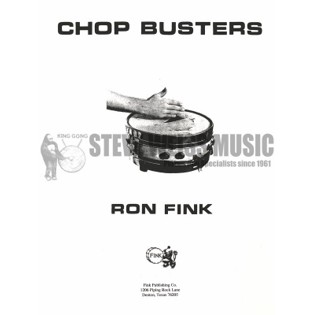
Best books - Chop Busters by Ron Fink
OK, the title is a little goofy- a lot goofy- but this is an excellent, fun book of snare drum exercises written by North Texas State University instructor Ron Fink to "uncover weakness in basic technique" and to "develop a) coordination of finger, wrist and forearm motions, b) sticking accuracy, c) speed, d) dynamics, and e) rhythmic recognition." They're organized by meter (2/4, 6/8, 3/4, 4/4, 2/2, and 12/8) and target tempo, and do not follow the usual mathematically logical sequence, running each idea well into the ground before proceeding to the next one. Exercises are not strictly rudiment based- they primarily deal with singles, doubles, accents, paradiddle variations, rolls, four stroke ruffs, and dynamics. Notably there are very few flam exercises.
There are a number of things I really like about this book. Any single page covers a number of issues, making it good for warming up, or for just giving yourself a break from some of the more mind-numbing technique books (cough *STICK CONTROL*). While challenging, you never get a sense that you are being asked to do something pointlessly difficult- the goal always seems to be to develop practical facility. There is a clear musical intelligence at work in writing and selecting exercises. It has something like the feel of a professional manual, focusing on vocabulary that will be useful in the field, rather than technique in the abstract.
And the price- it's 48 pages long and costs $4.50. A great value. Very fun and very nice to have around.
Get Chop Busters from Steve Weiss Music.
There are a number of things I really like about this book. Any single page covers a number of issues, making it good for warming up, or for just giving yourself a break from some of the more mind-numbing technique books (cough *STICK CONTROL*). While challenging, you never get a sense that you are being asked to do something pointlessly difficult- the goal always seems to be to develop practical facility. There is a clear musical intelligence at work in writing and selecting exercises. It has something like the feel of a professional manual, focusing on vocabulary that will be useful in the field, rather than technique in the abstract.
And the price- it's 48 pages long and costs $4.50. A great value. Very fun and very nice to have around.
Get Chop Busters from Steve Weiss Music.
Best books - Even in the Odds by Ralph Humphrey
The classic text on odd meter playing by Zappa/Don Ellis drummer Ralph Humphrey, this book covers swing, funk, and solo patterns in 5/4, 7/4, 5/8, 7/8, and longer odd time signatures. Each meter gets a concise treatment of four or five pages focused on learning its particular terrain. The written text is also minimal but effective- the instruction "repeat each exercise until a casual swing develops" is representative. This is a welcome change from many current books which tend to include way too many exercises, and assume a lot of ignorance (and isolation from real-world sources of information) with overly detailed verbal instructions. It appears to be geared towards college students who are going to tear through it, then run out and complete the process by applying it in performance.
For a partisan (like me) of the modern, interpretive Syncopation-based method of practice (reading a single melody line and orchestrating it for the drums on the fly), the process used in this book is rather old fashioned, in the Chapin mode. This entails learning by fully written-out one measure patterns, eventually adding up to at least a practical vocabulary, if not a lot of understanding. This does work well with the subject matter, though- many of us are back in the stone age (or at least the early days of the Chapin book) when it comes to odd meters, and it's fine to be spoon fed the patterns a little bit while the shape of the meters sinks in. And this book is well-constructed in that at leads you easily into going beyond the written exercises- in a way, it seems like the pinnacle of that approach.
One unusual thing is the way the swing sections are handled- most of the coordination deals with just the feet and ride cymbal. This is actually appropriate, given that odd meters tend to use rhythmic vamps (typically supported by the bass drum) instead of walking bass lines, in which the bass drum is used more for punctuation. The left hand is dealt with only briefly. Humphrey appears to be prioritizing in favor of getting the foundation together, and perhaps assuming that anyone using the book will have his left hand together, and be able to work it in once the foundation is solid. That has been my experience using the book, anyhow.
It's also notable that he explains the common ways of dividing measures into 3s and 2s, but does not segregate the exercises that way, and many of the exercises will "cross"- the cymbal pattern may be 3+2, but the feet are playing 2+3. This not for any musical effect I'm aware of- it seems to be more for the purpose of loosening things up, since odd meters tend towards boxiness.
The funk patterns have a little bit of that 70's thing going on, but that's OK; I'm becoming more of the opinion that book ideas should not be too hip. Let the student figure a few things out. It is a problem with Charles Dowd's odd meter book Thesaurus for the Jazz-Rock Drummer (renamed A Funky Thesaurus), which is more dated, with overly dense bass drum and snare drum parts. Again, we're just learning the shape of the measure, and it is left up to the student to find what works musically in performance.
The solo section also deals with a fairly narrow range of concepts- alternating accented single strokes and mixed stickings over running 8th notes, 16th notes, or triplets. While not getting too insane technically, the information in the section adds up to a good, flexible, practical improvising vocabulary. After learning it thoroughly musicians will be well set to take it much further.
Buy the book.
By the way, I do not have a relationship with Steve Weiss Music- I do not get anything for referring you to their site. Though I wouldn't mind it! They have a great selection of books I have not been able to find anywhere else, and their customer service has been good. If you purchase anything from them based on my reference, it would be lovely of you to make a note of it in your purchase order! Thanks! -tb
For a partisan (like me) of the modern, interpretive Syncopation-based method of practice (reading a single melody line and orchestrating it for the drums on the fly), the process used in this book is rather old fashioned, in the Chapin mode. This entails learning by fully written-out one measure patterns, eventually adding up to at least a practical vocabulary, if not a lot of understanding. This does work well with the subject matter, though- many of us are back in the stone age (or at least the early days of the Chapin book) when it comes to odd meters, and it's fine to be spoon fed the patterns a little bit while the shape of the meters sinks in. And this book is well-constructed in that at leads you easily into going beyond the written exercises- in a way, it seems like the pinnacle of that approach.
One unusual thing is the way the swing sections are handled- most of the coordination deals with just the feet and ride cymbal. This is actually appropriate, given that odd meters tend to use rhythmic vamps (typically supported by the bass drum) instead of walking bass lines, in which the bass drum is used more for punctuation. The left hand is dealt with only briefly. Humphrey appears to be prioritizing in favor of getting the foundation together, and perhaps assuming that anyone using the book will have his left hand together, and be able to work it in once the foundation is solid. That has been my experience using the book, anyhow.
It's also notable that he explains the common ways of dividing measures into 3s and 2s, but does not segregate the exercises that way, and many of the exercises will "cross"- the cymbal pattern may be 3+2, but the feet are playing 2+3. This not for any musical effect I'm aware of- it seems to be more for the purpose of loosening things up, since odd meters tend towards boxiness.
The funk patterns have a little bit of that 70's thing going on, but that's OK; I'm becoming more of the opinion that book ideas should not be too hip. Let the student figure a few things out. It is a problem with Charles Dowd's odd meter book Thesaurus for the Jazz-Rock Drummer (renamed A Funky Thesaurus), which is more dated, with overly dense bass drum and snare drum parts. Again, we're just learning the shape of the measure, and it is left up to the student to find what works musically in performance.
The solo section also deals with a fairly narrow range of concepts- alternating accented single strokes and mixed stickings over running 8th notes, 16th notes, or triplets. While not getting too insane technically, the information in the section adds up to a good, flexible, practical improvising vocabulary. After learning it thoroughly musicians will be well set to take it much further.
Buy the book.
By the way, I do not have a relationship with Steve Weiss Music- I do not get anything for referring you to their site. Though I wouldn't mind it! They have a great selection of books I have not been able to find anywhere else, and their customer service has been good. If you purchase anything from them based on my reference, it would be lovely of you to make a note of it in your purchase order! Thanks! -tb
Subscribe to:
Comments (Atom)