
Showing posts with label fills. Show all posts

Several big band drumming books

A couple of new/old big band drumming books dropped into my lap recently, so what the heck, I thought I'd round them up for you:

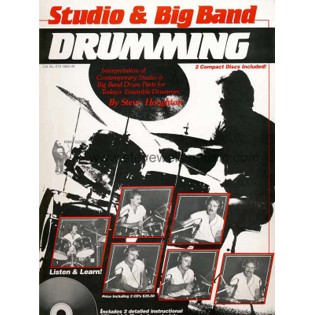
Studio & Big Band Drumming by Steve Houghton - 1985

This has been the definitive book on the subject for almost as long as I've been playing. Includes an essential, very concise but thorough explanation of terms and notation in professional charts. There are one or two page introductions to swing, rock, "Latin" and country styles. The swing section is good, the single page of Latin grooves is pretty dated; people have gotten much more serious about authenticity with those feels since the mid-80's. Probably most important for drummers are the pages on articulating a horn part, the "eighth note rule", and jazz phrasing. There are also many pages of sample ensemble figures, and authentic playalong charts.

College level. 68 pages, with 2 CDs of recorded figures, ensemble passages, and studio charts.


Stage Band and Drummer's Guide by John Pickering

"A guide to reading and understanding stage band charts." An excellent older book from Mel Bay, though I don't know how easy it will be to find a copy. I got mine used on eBay. Completely focused on chart interpretation, which it covers very thoroughly; aimed at somewhat more inexperienced readers, but explanations are presented with subtlety, and are not dumbed-down. Short on actual drumming vocabulary/technique- for that, get Houghton or Rothman. Includes many pages of sample figures.

High school to college level. 96 pages.


It's Time for the Big Band Drummer by Mel Lewis and Clem DeRosa

A unique book which I assumed was out of print until I found it at Steve Weiss Music- maybe it is out of print, and they've just got old copies on hand. It has just eight pages of Lewis' opinionated guidelines on every aspect of the instrument itself- drums, cymbals, heads, sticks, brushes- and two pages of musically-oriented technique, with the whole remainder of the book dedicated to chart analysis. Using a grand staff with the lead trumpet part on top and the drum chart on the bottom, the authors look at several well-known Thad Jones/Mel Lewis band charts, including Cherry Juice, Thank You, and Central Park North, with notes on interpretation.

College level. 46 pages.


Take a Break by Joel Rothman

More narrowly focused than the other books- and more specific about exactly what you are supposed to play- this thoroughly explores creative ways of setting up kicks. There is characteristically little in the way of written text- Rothman is an author who always seems to respect the role of the teacher, and does not over-explain his materials. And as always, he keeps a practical, playable approach. 66 pages.

High school to college level.


Honorable mention: Get Your Fills Together by Sonny Igoe

Another great out of print book, which I just saw in my friend Steve Pancerev's library. It's a classic I used briefly when I was in high school, and was able to leaf through Steve's copy, but didn't take in enough to say anything intelligent about it. Get a copy if you can find it. 

Sixtuplet plus release

This is something that came up in my practicing yesterday, and I went ahead and scribbled out a page of it for you. These sound good fast, but it's also a good idea to ask "what would Andy Newmark do?" and play them at slower tempos, or in half time, focusing on getting them to sit nicely. You should also take it a few steps further and figure out your own rhythmic variations and bass drum parts.


Get the pdf

16th note fills using Syncopation - part 2

Here's part 2 of my method for practicing 16th note fills using Syncopation. The goal is to practice reading interpretively, and also to give you a framework for working on the timing of your fills and kicks at different tempos. For example, if my fills aren't sitting the way I want them on a certain piece of music, I may run these exercises with a metronome set to the tempo of the piece. This can also be good for fine-tuning your accuracy before recording.


Part 1 was easy enough to read straight through once you learned a few lines of it, but part 2 is much less cut and dried. There are a lot of situations that make it difficult to apply the system exactly, so you have to make some creative decisions as you read. Hopefully you will also feel comfortable enough with the framework to feel free to take a few liberties with the system.

Review part 1
before trying this, then practice each line individually, then try running through lines 1-15 without stopping.

Download the pdf.

Basic big band set-ups

Another in the recent series of easy stuff, here is a page of basic set-ups for ensemble kicks on the & of 4. You can apply these to my earlier piece, Kicks and Set-ups Using Syncopation.


Download the pdf.

16th note fills using Syncopation - Part 1

This is the first part of a method for working on 16th note fills, which I developed for my intermediate students. It requires some selective reading, but in a constructive way- the same type of skill is required to read a chart or lead sheet. Use pp. 22-23 from Ted Reed's Syncopation. I suggest running through Reed ex. 1-15, plus the 20 bar exercise before proceeding to the next numbered item.

Feel free to post any questions in the comments.

Download the pdf

Kicks and set-ups using Syncopation

Here's a little method I devised for working on basic big band-style kicks and set-ups, using Ted Reed's Syncopation. Like many of the ways of working with Reed, it involves some selective reading/interpretation, but in a constructive way. We're not just making things difficult because we don't feel like buying another book- the interpretive skills developed in this method are very close to what's required in playing actual charts. The biggest leap of imagination is putting in the ties, and you can mark those in with a pencil if you want.


Download the pdf from www.pdxdrummer.com.