Showing posts with label teaching. Show all posts

Lessons are a whole different thing

Metaphor for complexity.
It's easy to wonder if drummers online are giving away the away the entire store with all of the free video lessons, blog posts and whatnot. With such a massive volume of free information available, what do students need teachers for?

Plenty, actually. Ignoring the fact that most free video "lessons" frankly suck (and that most blog posts are golden), learning even a straightforward written exercise is a complex process of coordination, technique, reading, comprehension of rhythm, touch, general physical posture, dynamics, and tone production, for starters. Most students are aware that those are words, but do not know how to implement them and balance them with each other in practice. In helping a student find an entry into some materials, there is a lot of:

"Do this-- no, not that, this-- no, this-- not quite, fix this one thing... good, almost... take a second and work that out, but pay attention to this, not this... wait, there's something you're doing that's very subtly wrong, let's fix that-- good, now you understand it well enough to practice it on your own." 

That's when things are going well; often you can throw into the mix some:

"OK, this isn't working, let's take it slower--- no, slower--- no, slower. Right, you need to take this slower. Good, it's still not happening. Let's break this town a little bit-- that's not working-- try it this way instead... still no good-- try just this piece of it. Great, add one more note..."

Beyond that, there is the matter of placing the practice item in context: How and how much does should he practice it? What more can he do with it? How does it connect to other things? How does he integrate it into his playing? How is it going to turn up in real-world drumming?

It can take considerable knowledge and ingenuity, instantly accessible. Most self-teachers can't cope with the multiple levels of real-world uncertainty in the process. And no written item or video, no matter how detailed, can address all of things that come up. Even if it could, the student would have to be able to digest it, and accurately self-monitor all of this stuff. Both of which are highly dubious prospects.

Coordination "kernels"

Here's one for the teachers. This is an approach I've found helpful with students having difficulties with coordination on written patterns in jazz and Latin, and a good alternative/supplement to the usual solution of "slowing it down", or going full Jeff Berlin and taking it out of time, which is to me not an acceptable solution for drummers. Using this method I've had students of differing abilities nail problem patterns up to tempo in fairly short order.

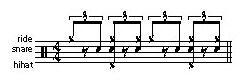
To begin, let's take a look at the jazz time feel as it's normally written:


The part we're interested in is the little clump of notes around "2 &-3":


That "kernel" is the true, natural shape of the jazz feel as it is executed, and which we'll be working with. So, let's take a fairly basic jazz comping pattern that challenges beginners:


We'll isolate the same little coordination unit, plus the snare pickup on the & of 1, and the other snare notes:


Read on to see how we work that up to performance tempo:


Play that by itself, one time only, until it's very solid at the target tempo, or close to it. Then start playing it over and over, counting as I've indicated, with an un-metered "grand pause" between each repetition. The pattern itself will be at the target tempo, the space will be as long as you need to collect yourself for the next repetition:


You could also treat the 3 and the 1 as fermatas; whichever, it's important that you don't keep counting or feeling a tempo during the pause. Stop, take a leisurely breath, then play the pattern again. As you get comfortable, you can gradually shorten the length of the pause until the repetitions flow together as God intended, as a steady stream of swing 8th notes:


It can be helpful to say "three" and "one" as long sounds as you begin flowing one repetition into the next.

Obviously, reducing tempo is the proven common method for overcoming coordination difficulties, but also introduces its own set of issues into the mix. Playing slowly is itself a special challenge, and I have reservations about reinforcing the idea of slow tempos as "training" tempos rather than fully fledged musical settings in their own right. Increasingly, I'm feeling that the mechanics of playing the same pattern at fast and slow tempos are so different that, really, it's not so much the same pattern after all. Finally, not every student at their current stage of development  has the patience or particular skill required to painstakingly reduce to turtle speed and gradually creep up to the target tempo. Those are important qualities, but I don't need every student to develop them at exactly this stage.