This is the second in an extremely short series covering the bare essentials of what you need for “drumistic” fill, variation, and solo material across a variety of styles— you can read the intro to the previous entry to get a sense of what I'm about here. Usually you arrive at these patterns via a Reed interpretation, but for my purposes here I wanted to present them in their complete state:
Play these with your right hand on the toms, snare, and/or cymbal with the bass drum in unison. Run them in a moderate-to-fast 4 (two or three notes per foot tap, that is), and in a moderate 2 (four or six notes per foot tap). Try to get off of the page as quickly as possible— there are actually only a few basic moves for each rhythm, and you should be able to improvise with these “by feel” pretty quickly.
Get the pdf
Showing posts with label technique. Show all posts
Three Camps round up
I recently picked up a stack of Mitchell Peters books, one of which contains several variations on this classic, and it seemed like a good time to round up the various sources and variations on it. In case anyone doesn't know, Three Camps is a military drumming piece over 200 years old, based on rolls and accents in a triplet rhythm. I've been playing it since drum corps legend Ghost (known to his mother as Bill Linen) taught me an unusual (possibly mis-remembered) version in 1982. Since at least Charles Wilcoxon's day, drummers have been using it as a template for working on other things- accented singles, paradiddles, ratamacues, etc. Here's what I could find online and in my own library:
Books
The Moeller Book, and Haskell Harr Drum Method, book 2
Each of these has it written out in the archaic notation, with an unusual ending in Harr- two 5-stroke rolls plus release. Due to the notation they're pretty useless to modern users readers.
Rudimental Swing Studies for the Advanced Drummer by Charlie Wilcoxon
In traditional form, paradiddles, and ratamacues. Unfortunately both the original edition and the typo-riddled Sakal edition present it with the old-fashioned notation, though it's marginally more readable than the Moeller version. (To be fair to Mr. Sakal, I think there are many more typos in his edition of Rolling in Rhythm than in RSS. Still looking for an original edition of RIR to confirm that...)
Intermediate Snare Drum Studies by Mitchell Peters
Includes the usual triplet roll form (in modern notation), and in rolls with a 16th note, quintuplet, and sixtuplet pulsation.
Variations on Three Camps by Marvin Dahlgren
This was an unexpected find. I was continuing my so-far-in-vain search for a copy of Dahlgren's Drum Set Control, and came across Really Good Music, which publishes his books- including DSC. According to the site: "The first half of the book is designed primarily for Snare Drum. The second half is designed for use with Drum Set. As usual with Marv Dahlgren books, one can easily spend the rest of your life perfecting these patterns. This 61 page book is in easy to read manuscript with sticking patterns indicated." Naturally I ordered a copy- along with DSC and a book I had never heard of, Complete Text for the Rock & Roll Drummer. I'll let you know when I get them.
Variazioni in Three Camps by Daniele Sabatini
Never seen this before. Ten different variations. No information on what they are, but the preview has it written in flamacues. Available through a German site.
Online versions after the break:
Online
Snarescience.com
Written as triplets, no rolls, with a modified ending- two beats of accented triplets plus a release, instead of the traditional triplet figure with a ruff, or the four-beat fp roll which is the way I learned it. The Accent Percussion Project has an identical version.
In the snarescience.com forum there's also an unusual polyrhythmic version- the first page of it, anyway- someone who calls himself teh_guardian has changed the note values to 8th notes, while keeping the same actual number of notes, giving a 6/8-within-4/4 feel.
Rudimentaldrumming.com
Here's an otherwise conventional version written as sixtuplets in 2/4, using Berger notation.
Robinengelman.com
The image above is from a c. 1784 book mentioned on Engelman's site- it's not complete, so I include it here as a curiosity. You could write him and ask for a scan of the complete piece.
And there's my screwy old version, which has the 3rd camp in the middle, and no restatement of the second camp. There was a period of years from the late 80's to the mid 90's when I never played it- I might've remembered it wrong when I recovered it. I think I'm right, though- I remember it being substantially shorter than the traditional version. And it's hard to forget these things once you've played them hundreds of times.
Finally, I saw Elvin Jones perform it on the drums in a clinic c. 2000; he doubled the accents with the bass drum, and played a two measure drum solo at the end of each time through. I was hoping there would be video of that (or at another clinic) on YouTube, but no.

Books
The Moeller Book, and Haskell Harr Drum Method, book 2
Each of these has it written out in the archaic notation, with an unusual ending in Harr- two 5-stroke rolls plus release. Due to the notation they're pretty useless to modern users readers.
Rudimental Swing Studies for the Advanced Drummer by Charlie Wilcoxon
In traditional form, paradiddles, and ratamacues. Unfortunately both the original edition and the typo-riddled Sakal edition present it with the old-fashioned notation, though it's marginally more readable than the Moeller version. (To be fair to Mr. Sakal, I think there are many more typos in his edition of Rolling in Rhythm than in RSS. Still looking for an original edition of RIR to confirm that...)
Intermediate Snare Drum Studies by Mitchell Peters
Includes the usual triplet roll form (in modern notation), and in rolls with a 16th note, quintuplet, and sixtuplet pulsation.
Variations on Three Camps by Marvin Dahlgren
This was an unexpected find. I was continuing my so-far-in-vain search for a copy of Dahlgren's Drum Set Control, and came across Really Good Music, which publishes his books- including DSC. According to the site: "The first half of the book is designed primarily for Snare Drum. The second half is designed for use with Drum Set. As usual with Marv Dahlgren books, one can easily spend the rest of your life perfecting these patterns. This 61 page book is in easy to read manuscript with sticking patterns indicated." Naturally I ordered a copy- along with DSC and a book I had never heard of, Complete Text for the Rock & Roll Drummer. I'll let you know when I get them.
Variazioni in Three Camps by Daniele Sabatini
Never seen this before. Ten different variations. No information on what they are, but the preview has it written in flamacues. Available through a German site.
Online versions after the break:
Online
Snarescience.com
Written as triplets, no rolls, with a modified ending- two beats of accented triplets plus a release, instead of the traditional triplet figure with a ruff, or the four-beat fp roll which is the way I learned it. The Accent Percussion Project has an identical version.
In the snarescience.com forum there's also an unusual polyrhythmic version- the first page of it, anyway- someone who calls himself teh_guardian has changed the note values to 8th notes, while keeping the same actual number of notes, giving a 6/8-within-4/4 feel.
Rudimentaldrumming.com
Here's an otherwise conventional version written as sixtuplets in 2/4, using Berger notation.
Robinengelman.com
The image above is from a c. 1784 book mentioned on Engelman's site- it's not complete, so I include it here as a curiosity. You could write him and ask for a scan of the complete piece.
And there's my screwy old version, which has the 3rd camp in the middle, and no restatement of the second camp. There was a period of years from the late 80's to the mid 90's when I never played it- I might've remembered it wrong when I recovered it. I think I'm right, though- I remember it being substantially shorter than the traditional version. And it's hard to forget these things once you've played them hundreds of times.
Finally, I saw Elvin Jones perform it on the drums in a clinic c. 2000; he doubled the accents with the bass drum, and played a two measure drum solo at the end of each time through. I was hoping there would be video of that (or at another clinic) on YouTube, but no.
Matt's paradiddle thing
This is a straightforward paradiddle exercise I wrote up for one of my students. It ends up a pretty robust page of stuff when you run it in the sequences.
Practice each measure individually, then play them as follows:
Two or four times each:
1, 2, 1, 3, 1, 4... 2, 3, 2, 4, 2, 5... 3, 4, 3, 5, 3, 6... etc
Two-pattern sequences, one measure of each, repeated 2-4 times:
1-2, 1-3, 1-4... 2-3, 2-4, 2-5... 3-4, 3-5, 3-6...
Note that the sixtuplet patterns will reverse stickings on the repeat, which will make some interesting things happen when you get to the sequences. You can of course add variations to include accents on the doubles; I just wanted to keep it to a manageable size.
Download the pdf
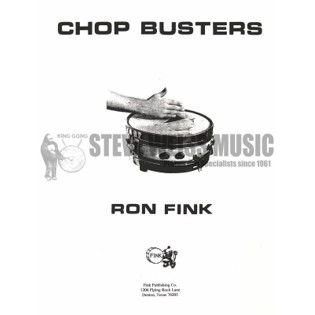
Best books - Chop Busters by Ron Fink
OK, the title is a little goofy- a lot goofy- but this is an excellent, fun book of snare drum exercises written by North Texas State University instructor Ron Fink to "uncover weakness in basic technique" and to "develop a) coordination of finger, wrist and forearm motions, b) sticking accuracy, c) speed, d) dynamics, and e) rhythmic recognition." They're organized by meter (2/4, 6/8, 3/4, 4/4, 2/2, and 12/8) and target tempo, and do not follow the usual mathematically logical sequence, running each idea well into the ground before proceeding to the next one. Exercises are not strictly rudiment based- they primarily deal with singles, doubles, accents, paradiddle variations, rolls, four stroke ruffs, and dynamics. Notably there are very few flam exercises.
There are a number of things I really like about this book. Any single page covers a number of issues, making it good for warming up, or for just giving yourself a break from some of the more mind-numbing technique books (cough *STICK CONTROL*). While challenging, you never get a sense that you are being asked to do something pointlessly difficult- the goal always seems to be to develop practical facility. There is a clear musical intelligence at work in writing and selecting exercises. It has something like the feel of a professional manual, focusing on vocabulary that will be useful in the field, rather than technique in the abstract.
And the price- it's 48 pages long and costs $4.50. A great value. Very fun and very nice to have around.
Get Chop Busters from Steve Weiss Music.
Subscribe to:
Posts (Atom)