Swing interpretation is something we use a lot here, and I've mostly assumed people know what it is— you probably wouldn't be reading all of this high-flying jazz drumming nonsense if you didn't. It's still a good idea to spell it all out, so people aren't working with partial information; so here are my ideas about it. I'm a player who happens to also be a teacher, and not a scholar, so other people may have different, better, or more complete ideas about it, despite the unequivocal-sounding title of the post.
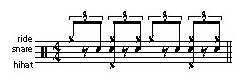
Swing is a way of playing 8th notes. If you look at a fake book, a big band chart, or sheet music for standard tunes, for the most part they are written in regular old 4/4, using mostly 8th notes and longer rhythmic values:
Often explanation of how to play that with a swing feel is limited to this, or its verbal equivalent:
Swing = triplets. Got it. NEXT!
Except... no. Swing = triplets approximately the same way a “flesh”-colored Crayola = the color of human flesh:
That is, the circumstances under which flesh is flesh crayon colored are actually rather few, depending on the complexion of the individual, and the lighting in which he or she is viewed. Likewise with music, swing interpretation varies according to the player, the tempo and style of the piece, and what's going on musically at the moment.
Continued after the break:
Showing posts with label jazz. Show all posts
Alan Dawson's “Ruff Bossa”
We're laying it on pretty thick with the Reed interpretations right now, but I just went over this with a student, so I need to put up one more. It's a swing interpretation with partially filled-in triplets, using the 8th note rest and syncopation sections of Reed (pp. 29-44 in the old edition). Alan Dawson called this the “Ruff Bossa” interpretation for reasons I can't fathom— there are no ruffs involved, and I can't discern the Bossa Nova connection.
So here's how to interpret each written beat of the exercises, based on how the notes sound; after p. 32 you'll be dealing with rhythms that are equivalent to the ones below, but are written differently.
Play written 8th notes as alternating swing 8ths:
Play written quarter notes (or the equivalent) as an 8th note triplet with a RLL sticking, accenting the right hand:
Play notes sounding on an & only as a triplet with a RRL sticking, accenting left:
On beats where there's no note sounding— like if there's a rest, or the end of a tied/dotted note, or some combination thereof— use whichever triplet sticking you like, but don't accent.
Examples after the break:
Houghton's triplets
From Steve Houghton's book Studio and Big Band Drumming, here's an alternate sticking method for making triplets out of Syncopation. For most people the most familiar method is to play the melody notes— the written rhythm in Reed— with the right hand, and fill out the triplets with the left. I'll modify that to avoid playing more than two hits in a row with the left, using (as few as possible) alternating strokes. Houghton also puts all of the accents on the right hand, but takes the opposite approach with the inside notes: he plays as many alternating notes as possible, and as few doubles.
Examples after the break:
Here are a couple of examples, from the first long exercise in Reed, on page 37 in the old edition. The first line as written:
Played:
Another line from that page:
Played:
These fairly dense examples don't end up being all that different from the way they would be played using my method; they become much more alternating stroke-dominated when interpreting melodies that have more long notes and rests.
Expanding on The Kenny Note
What we have here are some very basic comping ideas based on the so-called (by me only, I'm sure) "Kenny" note-- a snare drum punctuation on the & of 1 or the & of 3. A student is having some difficulties bringing his comping practice into his actual playing, and we had some success starting with this approach of starting with one note, and adding things to it:
You could also call this "jazz comping survival chops"; a bare minimum of stuff that will sound like a lot more than the sum of its parts, if applied musically. Memorize the patterns as you practice them, then throw the page away and improvise with them while playing along with a recording or singing a tune. In general you don't want to play them repetitively in actual music; mix them up, and put in more space (where you just play time) between ideas. Listen to recordings of Kenny Clarke or Connie Kay to get an idea of the level of density to shoot for at first.
Get the pdf
Tom moves
This Elvin thing is turning into a real epic- well, a very small epic, maybe, if you think about it- and I still have to complete the transcription. Here are the tom moves I would apply to the left hand part on yesterday's post- you can/should do these with any other left hand coordination materials, too, of course.
Key:
S = snare drum (normally, or as a rim click)
H = high tom
L = low tom
Between two drums:
S H S H
S L S L
H L H L
Away from/back to one drum:
S H S L
H S H L
L S L H
Up and down the drums:
S H L
S L H
You can extrapolate your own patterns if you have one of those monster drumsets with three tom toms. I like to do things the easy way, so I do the moves when there's plenty of time- I don't split the doubles between drums. Depending on the number of notes in the rhythmic pattern vs. the particular move above, there will often be a little polyrhythmic counter-melody generated by doing these- it's a good idea to count out loud and keep track of the four measure phrase in that case. When doing this Elvin thing, for example, count 1-2-3, 2-2-3, 3-2-3, 4-2-3.
Several big band drumming books
A couple of new/old big band drumming books dropped into my lap recently, so what the heck, I thought I'd round them up for you:
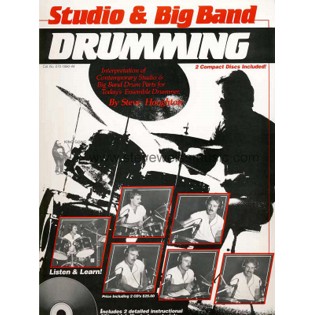
Studio & Big Band Drumming by Steve Houghton - 1985
This has been the definitive book on the subject for almost as long as I've been playing. Includes an essential, very concise but thorough explanation of terms and notation in professional charts. There are one or two page introductions to swing, rock, "Latin" and country styles. The swing section is good, the single page of Latin grooves is pretty dated; people have gotten much more serious about authenticity with those feels since the mid-80's. Probably most important for drummers are the pages on articulating a horn part, the "eighth note rule", and jazz phrasing. There are also many pages of sample ensemble figures, and authentic playalong charts.
College level. 68 pages, with 2 CDs of recorded figures, ensemble passages, and studio charts.
Stage Band and Drummer's Guide by John Pickering
"A guide to reading and understanding stage band charts." An excellent older book from Mel Bay, though I don't know how easy it will be to find a copy. I got mine used on eBay. Completely focused on chart interpretation, which it covers very thoroughly; aimed at somewhat more inexperienced readers, but explanations are presented with subtlety, and are not dumbed-down. Short on actual drumming vocabulary/technique- for that, get Houghton or Rothman. Includes many pages of sample figures.
High school to college level. 96 pages.
It's Time for the Big Band Drummer by Mel Lewis and Clem DeRosa
A unique book which I assumed was out of print until I found it at Steve Weiss Music- maybe it is out of print, and they've just got old copies on hand. It has just eight pages of Lewis' opinionated guidelines on every aspect of the instrument itself- drums, cymbals, heads, sticks, brushes- and two pages of musically-oriented technique, with the whole remainder of the book dedicated to chart analysis. Using a grand staff with the lead trumpet part on top and the drum chart on the bottom, the authors look at several well-known Thad Jones/Mel Lewis band charts, including Cherry Juice, Thank You, and Central Park North, with notes on interpretation.
College level. 46 pages.
Take a Break by Joel Rothman
More narrowly focused than the other books- and more specific about exactly what you are supposed to play- this thoroughly explores creative ways of setting up kicks. There is characteristically little in the way of written text- Rothman is an author who always seems to respect the role of the teacher, and does not over-explain his materials. And as always, he keeps a practical, playable approach. 66 pages.
High school to college level.
Honorable mention: Get Your Fills Together by Sonny Igoe
Another great out of print book, which I just saw in my friend Steve Pancerev's library. It's a classic I used briefly when I was in high school, and was able to leaf through Steve's copy, but didn't take in enough to say anything intelligent about it. Get a copy if you can find it.
Stick Control implied rhythms
I hope you dig all of this Stick Control stuff; I just happen to be working with this book a lot right now. One of my reservations I've always had about it- about the way the first three pages apply to the drums, anyway- is that the musical content is hidden behind the sticking patterns. And I don't want to base my playing on patterns of Rs and Ls, I want to base it on common musical language. So what I've done here is give the rhythm suggested by the right hand part of exercises 1-72 from the front of the book; if you drop out the left hand, or accent the right, these are the rhythms that pop out. I've written the more syncopated rhythms jazz style (as in Ted Reed), with long notes on the &s wherever possible. For easy reference, I've put them in the same format as the original:
Keeping these pages handy while working with the Stone exercises on the drumset will get one seeing the rhythmic content behind the exercises in fairly short order. If like me you use Stone and Reed a lot, hopefully making the connection between the two will encourage some different ways of thinking about each. I would be cautious about the way you apply this to snare drum practice, however; hanging everything off of the right hand is a normal thing on the drums, but when working strictly on hand technique you want to be more balanced.
Get the pdf.
More Stone on the drums
Here's something timely to the ECM feel post. I've been using Stick Control quite a bit in my practicing lately- particularly my application in 5/4 (and a similar thing in 7/4), and in fooling with it began using this simple but effective variation:
These are most effective in a moderate to bright 2. Definitely experiment with substituting your own fills for the given triplets/roll.
Get the pdf.
These are most effective in a moderate to bright 2. Definitely experiment with substituting your own fills for the given triplets/roll.
Get the pdf.
Getting lost
| Or not. |
Here are a few pointers on a subject with which I am all too intimately familiar: getting lost while soloing over over a form, and while reading:
SOLOING
First, whatever various hells break loose during your solo, you can always just cue the band back in at the end. Set them up by playing something that sounds like a last A (assuming an AABA form)- going back to playing time would suggest that- and make significant eye contact with the rest of the band. If they're not deliberately hanging you out to dry, they'll come in at the end of the 8 bars, especially if you give them a nice bonehead-simple lead-in on the last measure. If they don't follow you, you can play eight more bars and then verbally count them back in. They would have to really have it in for you to ignore that.
You do also have to know the tune. Be able to sing the melody badly, know the length and structure of the form (12 bar blues, AABA, 32 bars + tag, 16+16, etc), and know the standard arrangement, if there is one (e.g., the repeated figure on Stolen Moments, or the stops in Work Song). At the very least you have to know the form.
Something you can do at the actual moment of getting lost is to just guess where the nearest reference point is; so if you get lost in the middle of the second A, then make a big downbeat and change the texture someplace that could plausibly be the beginning of the bridge, and carry on with the form from there. Who knows, you might even guess right. Even if you don't, most of the band will suspect that they counted wrong, and half of the rest of them aren't even paying attention. The actual cats will know that you blew it, and recovered. It doesn't matter.
More helpful tips after the break:
What's the longest phrase you can play without getting lost? If you can play 8 bars or a chorus of blues, you're in. After that it's just a matter of having the presence of mind to know whether you're on the first, second, or last A, or the bridge. Or whatever part of the form in question.
It's common for novices to forget which of the three A sections they're on, so beware of that. Maybe mentally screaming "TOP!" to yourself after the last A will help you keep them straight; get used to thinking bridge, last A, TOP! at the beginning of each of those sections, respectively. The first two A's should take care of themselves.
Simplify. You can probably play time unaccompanied through the form without getting lost. Build on that. Do a tactical retreat from your massively displaced/polyrhythmic hell-of-notes chops-fest, and just play time, adding things as you are able to without losing it.
READING
These mostly apply to the type of reading I've been doing these days- challenging one or two page lead sheets:
Watch out for odd phrases. Is the form 4+4+4+5 bars? When you get to that last phrase, you're going to have to remember every time that there's an awkward extra bar. So don't get too comfortable at that spot- count through it. That goes double for any random, momentary meter changes the composer/arranger decides to throw at you.
Watch and listen for variations in the harmonic rhythm. That's the rate at which the chords change. If most of the changes happen once per measure, but there are two per measure in a few spots, you should be able to hear it and orient around them.
Figure out where your harmonic home base is. As you hack through the chart the first time, listen for the comfy-sounding chords, and remember where they are on the page. Get used to cuing off their sound when they recur elsewhere in the chart. With our recent "tune of the moment" Feet First, for example, there's D-7/A-7 thing that happens at the top, and throughout the piece. You should be able to hear that when it comes up later. You don't have to know a D-7 from a DX7 to do this; once you find it on the chart and start listening for it, it will be as distinctive as someone hitting a cowbell at that spot.
Basic solo vocabulary with Syncopation
Hey, it's been awhile since I've posted anything downloadable of my own, and you don't want to hear me prattle on about cymbals and crap, so here's a basic solo vocabulary builder I've been working through with a couple of students. Use lesson 6 out of the new edition of Syncopation, or pp. 14-15 from the old version:
You have to apply the variations with a vengeance to make these sound like anything. Especially vary the accents- give the thing some shape.
Get the pdf
You have to apply the variations with a vengeance to make these sound like anything. Especially vary the accents- give the thing some shape.
Get the pdf
Putting together a jazz drum set
![]() |
| The Gretsch Catalinas on my 2010 Europe tour. |
So here we go- my epic user's/buyer's guide for getting your jazz instrument together:
Cymbals
Cymbals, particularly the ride cymbal, are the most important part of the set for a jazz musician. Part of the philosophy- I'm paraphrasing Mel Lewis here- is that you treat every cymbal as both a ride and a crash; so you don't want your ride be too heavy or your crash to be too small/light. Your ride cymbal should be 20 or 22", light to medium weight; your left-side cymbal can either be a 17-18" thin to med. thin crash, or an 18-19" light to medium ride, or "crash-ride"; hihats 13-15", light to medium.
We're in a golden age of cymbals right now, with people like Bosphorus, Zildjian, Sabian, Paiste, Meinl, Istanbul, and many smaller companies making incredible hand hammered cymbals. One side effect of which is that the prices on regular old professional quality cymbals of the 70's-90's have come way down; and people have gotten pickier about appearance, so really dirty, funky-looking cymbals are even cheaper. People who only care about the sound can find some real bargains in A. Zildjians, Sabian AAs, Paiste 2002s and 3000s. Grungy-looking is good, tiny cracks (less than 1 cm) are acceptable (and will bring the price way down), "keyholing" is perfectly fine for you, but a good bargaining point for bringing the price down further.
Keep reading- it's a long post and there's much more information after the break:
But as soon as you can save up about $275-325 for a used 20-22" jazz cymbal made by any of the companies above, you should do it. K-type cymbals are very variable in sound, so be sure to play or at least listen to an audio sample of a cymbal before buying. Or if you can find an online dealer who's judgement you trust- I like Cymbals Only- they can hand select one for you. I should mention that I have never heard a bad thin to medium thin Bosphorus... I personally would feel comfortable buying one blind.
A couple of moderately priced options are the new Sabian Raw ride, and the old Paiste 602 ride- 602s are a jazz classic in their own right, and have been used on a lot of great records. They can vary wildly in price, but 20" rides from the 60's (no printing on the cymbal, and no serial number) can be had in the $180-220 range, approximately the same as a used Sabian Raw.
A good way of salvaging a slightly too-heavy ride cymbal- like if the only decent cymbal in your price range is a used 22" A. Zildjian ping ride- is to install rivets, making it into a sizzle cymbal. You can do this instead with your second cymbal (usually on the left side- the "crash" cymbal position) if you find yourself with a heavyish 18-19" cymbal. Any drum shops should install them for you, but really, anyone with a drill press can do it.
Sticks
I've found that maple sticks get a more musical sound out of the drums than hickory; the wood is lighter, so you can use a fatter stick and still be quieter. Vic Firth SD-4 Combos are very popular, but I find them too small, and the sound too thin. I use SD-11 Slammers, which are about the size of a 5B; I can play quietly with them but still get a full tone. If you decide to stay with hickory, something smaller than a 5A is a good idea- either a 7A or one of the many signature models available.
You're also going to need to own some brushes and mallets. Any old brand of rubber handled telescoping metal brush will do fine. I prefer the Pro-Mark TB-3. Mallets tend to get destroyed, so I use whatever is cheapest at the moment- maple handles are preferred, along with a head that is not too hard or too fluffy.
Drums
The first thing you can do with your drums is tune them higher, and remove all muffling. If you're using heavier heads, like Remo Pinstripes, you should probably replace your heads- any normal medium-weight, single-ply head, coated or uncoated, will do. Coated Remo Ambassadors are standard; Remo Renaissance are also a nice option. You can get away with a slightly heavier had on the bass drum, with light muffling.
If you do need (or want) to get some new drums, the standard jazz sizes are 18 or 20" bass drum, and 12 and 14" toms. Any snare drum is fine- I favor a 13" because I prefer a low tuning, and can achieve without dropping the pitch too extremely. Much ink/bandwidth has been spilled/expended(?) discussing the question of whether you really need "jazz" sized drums, but in the end, smaller drums have the sound and appearance the other musicians expect, respond best to the type of touch you use in a jazz setting, and are the most versatile- with the right tuning you can use them with just about any type of music.
The option du jour for cheap jazz sets is the Gretsch Catalina with the 18" bass, and 12 and 14" toms. They look just like a real jazz drum set, are the right sizes, and are reasonably inexpensive- there are so many of them around that the used prices must be coming down a bit. Origin Records has a set permanently in Europe for touring artists, which I have used, and I can't say I'm absolutely wild about the sound, but a lot of people are using them.
A set I have a lot of experience with is the Tama Imperialstar Compact- called the Stagestar until a couple of years ago. Includes an 18" bass drum, with 10, 12, and 13" toms (the floor tom may be a shallow 14"- it's been a little while since I've played one of these). I like these a lot- they tend to be a little cheaper than the Gretsches, have better hardware, and have an extra drum in case you want to fusion out. The appearance is just a little bit more "student" looking than the Gretsch.
The Yamaha Manu Katche mini kits are also a good, very inexpensive option. The drums are very small- 16" bass, and 10 and 12" toms, so the sound is bordering on extreme, but they are entirely usable, surprisingly versatile, easy to schlep, and very fun to play. I owned a set of these for a couple of years.
The extreme budget option, if you're young and/or poor- or only care about the music- is a First Act set (don't get this model with the skulls). It's got an 18" bass drum, 10 and 13" toms, and I believe a 13x4" snare. They're a little funky-looking , and the hardware is rather flimsy, but can be found used on Craigslist for $50-100, and really sound just fine.
A final thought: don't get too caught up in your instrument, especially in its appearance- what you play is what matters. Remember that you become a player by playing, listening, and watching.

Coordination "kernels" - further examples
You may have noticed I've been on rather light posting this last week. Expect that to continue for the next several days; this week I'll be recording my new CD for the Origin label, Little Played Little Bird (the music of Ornette Coleman; stay tuned for info on pre-ordering!), and have been very busy with pre-production stuff. Mainly obsessing over my charts- transcribed off the record and arranged by me- and practicing.
Today at least I have some examples relating to my earlier coordination kernels post. These are taken from Jim Chapin's Advanced Techniques for the Modern Drummer, plus a couple of generic versions of the Afro-Cuban cascara, which you can read more about in Malabe & Weiner's Afro-Cuban Rhythms for Drumset, among other places:
Refer back to the original post for instruction on how to apply my method. Note that each cascara groove is composed of three "kernels". Learn each one individually, and then put them together as outlined previously; first with open space between each kernel, then gradually flowing from one to the next until they make the desired rhythm of the complete groove.
Get the pdf.
How to be a jazz drummer
Here are some tips for a rock drummer who wrote to me wanting to begin learning jazz, but is unsure how to go about it:
1. Play a lot. With people. Everything you do as a drummer follows from this, so it's important to be playing with people from earliest possible stage- as soon as you can play a swing beat. Or sooner- I actually didn't know how what a swing beat was, exactly, when I first got into jazz band in school. You learn very quickly when you're put on the spot. Don't become so focused on practice and preparation that you don't do this.
2. Listen to a lot of jazz. Usually people start with whatever turns them on, plus the more famous recordings of the 1950's and '60's. Building a record collection and generally having a lot of curiosity about the music are universal things among jazz musicians.
3. Go to jazz gigs. You need to see how drummers play the actual gigs you'll be playing in your own town. YouTube clips are good, but they don't tell you how to do that. This is also how you meet the people who you'll be playing with, your teachers, and your audience.
These first three are critical and non-negotiable. After the break are some more important things- read on:
4. Learn tunes. The easiest way to do this is to play with people, but you should do some homework, too. You could start with these Charlie Parker tunes, or just attack A Blog Supreme's list of the "top" 100 jazz tunes. Learning a tune means, for starters, that you can sing the melody (badly, even) from memory, play the rhythm on the snare drum, and can recognize it when you hear it; and that you know the form of the tune (12 bar blues and 32 bar AABA are common examples), as well as any common kicks/stops, and the usual tempo and style. You can view lead sheets for just about any tune you'll want to learn at Jazz Planet.
5. Get a teacher. Preferably the best jazz drummer in your town who is also a good teacher, who you also feel clicks with you personally (hopefully). He can keep you focused on what's actually important (have you noticed the myriad of distracting, non-essential drumming crap thrown at you every day?), can find different ways of teaching you things you're having trouble with, can give you instant feedback, and correct big misconceptions (of which you will have many). Books and videos are great and necessary, but they can't do these things.
6. Be a part of a program. If you're still in school, be in the band program. You'll get a little bit of playing and performing in, meet people to play with outside of school, and learn from the other students who are better than you.
7. Get your general musical and drumming skills together. Get proficient with reading music, learn your rudiments, and practice your concert snare drum. Participating in concert band, orchestra, and/or marching band is a good idea. Getting at least a basic understanding of the tonal world- scales, chords, and such- is also helpful.
8. Practice. Most jazz musicians are serious lifetime practicers, and you'll need to go through at least a period of years where you dedicate a lot of time and energy to it.
Being overwhelmed by the amount of stuff to work on is sort of a natural state for jazz musicians, but try to be. Just put one foot in front of the other- if you're generally participating in all of the above things and working hard, it will happen.
Coordination "kernels"
Here's one for the teachers. This is an approach I've found helpful with students having difficulties with coordination on written patterns in jazz and Latin, and a good alternative/supplement to the usual solution of "slowing it down", or going full Jeff Berlin and taking it out of time, which is to me not an acceptable solution for drummers. Using this method I've had students of differing abilities nail problem patterns up to tempo in fairly short order.
To begin, let's take a look at the jazz time feel as it's normally written:
The part we're interested in is the little clump of notes around "2 &-3":
That "kernel" is the true, natural shape of the jazz feel as it is executed, and which we'll be working with. So, let's take a fairly basic jazz comping pattern that challenges beginners:
We'll isolate the same little coordination unit, plus the snare pickup on the & of 1, and the other snare notes:
Read on to see how we work that up to performance tempo:
Play that by itself, one time only, until it's very solid at the target tempo, or close to it. Then start playing it over and over, counting as I've indicated, with an un-metered "grand pause" between each repetition. The pattern itself will be at the target tempo, the space will be as long as you need to collect yourself for the next repetition:
You could also treat the 3 and the 1 as fermatas; whichever, it's important that you don't keep counting or feeling a tempo during the pause. Stop, take a leisurely breath, then play the pattern again. As you get comfortable, you can gradually shorten the length of the pause until the repetitions flow together as God intended, as a steady stream of swing 8th notes:
It can be helpful to say "three" and "one" as long sounds as you begin flowing one repetition into the next.
Obviously, reducing tempo is the proven common method for overcoming coordination difficulties, but also introduces its own set of issues into the mix. Playing slowly is itself a special challenge, and I have reservations about reinforcing the idea of slow tempos as "training" tempos rather than fully fledged musical settings in their own right. Increasingly, I'm feeling that the mechanics of playing the same pattern at fast and slow tempos are so different that, really, it's not so much the same pattern after all. Finally, not every student at their current stage of development has the patience or particular skill required to painstakingly reduce to turtle speed and gradually creep up to the target tempo. Those are important qualities, but I don't need every student to develop them at exactly this stage.
Big band figure builder
Here's another installment of a thing I've been doing with several students, using Syncopation lesson 4 to get familiar with the basic moves and reading associated with setting up and kicking big band figures ("cutting" them, that is), or just interpreting a melody line on a lead sheet. The process is broken down to a number of logical, easy- darn near banal- interpretive steps. Read them carefully, and apply them to exercises 1-15:
These related posts should be very helpful: simple variations on lesson 4, kicks and set-ups using Syncopation, and basic big band set-ups.
Get the pdf.
These related posts should be very helpful: simple variations on lesson 4, kicks and set-ups using Syncopation, and basic big band set-ups.
Get the pdf.
Basic Mambo
I guess I had to eventually post something directly drumming-related on my drumming blog, so here is an older piece I'll be sharing with a couple of students today- some variations on a generic, very basic one-measure mambo-type Latin pattern. Some form of this is usable in actual playing where strict authenticity isn't a primary concern (and there are many such situations), at bright tempos, or when playing with inexperienced musicians unable to follow the more correct patterns.
Get the pdf.
Get the pdf.
Simple variations on Syncopation, Lesson 4
That's pages 10-11 for those of you with the old edition- as you can see I've given up completely and started referring to the parts by their new edition names. I've been working with this section of the book a lot with my students, for rock (and another), jazz, and Latin, and have developed a few methods for my own practice for it.
These variations require just a little selective reading, and are very good for making this underused section of the book a little more interesting. I'll outline later the exact method I've been using with my students; I've found it's very helpful in getting them accustomed to reading figures, and manipulating some of the basic elements of ensemble playing in jazz drumming.
This is a good companion to my piece using this same section for making big band kicks/set-ups.
Get the pdf.
Why we transcribe
| Yes, I look the same when I'm transcribing as Duke did when he was copying parts- immaculately-coifed, reclining in my suit surrounded by reams of parchment. |
Why I transcribe:
- To facilitate listening. All the other whys follow from this.
- To see exactly how a drummer does his job. How he handles the craft end of things- time feel, ensemble figures, set ups, fills, comping. This is a short entry, but a really big thing.
- To get a sense of the size of tool box a drummer brings to a performance. How many types of things does he play? How many ideas?
- To clarify mysterious things. Some drummers play things that are easy to understand, some play things that defy real instant analysis- Elvin Jones and Jack Dejohnette are examples of that. In the case of Vinnie Colaiuta, I might want to see how in the hell he gets through an extended guitar solo in 19/16.
- To get statistical information- how often he make strong crashes, how often he uses the toms, how often does he vary or leave the ride cymbal. How much space he leaves, how long he stays at certain dynamic levels. I just want a better impression of those things than I might get just from listening- I'm not actually counting up cymbal crashes.
What I don't do:
- I don't transcribe to learn cool things to play on the drums. Musical context is the entire point. So I don't transcribe burning "set piece" drum solos that have nothing to do with anything musically.
- I don't play my transcriptions. My feeling is that on the drums especially, it's a little bit like trying to forge someone's signature- you can mimic the outward appearance, but not the true process.
Issues:
- Limits of audibility, accuracy. Due to recording technology, the mix, and the extreme dynamic subtlety of the musicians, you simply aren't going to be able to get every single note much of the time.
- Invisible (I should probably say silent) things like stickings. There is a lot of invisible-to-the-recording content to Buddy Rich's playing, for example. A number of other drummers are this way. It's a particular challenge of brush transcriptions, in which case I just get what is audible and ignore stickings and brush patterns altogether.
- Playability. Often what is audible will be so sketchy that it presents an incomplete, misleading picture of what was played, making for an unplayable transcription.
- Readability. When transcribing for general consumption, I follow the KISS rule. Don't overdo it with the gradations of dynamics and rhythm, and try to resolve sketchy passages to at least make drumistic sense. If it's clear that there is a lot of only occasionally audible snare drum ghosting or bass drum feathering going on, I leave it all out, and make a written note that I have done so. Leave something for people to discover as they work through it.
- Getting the result but missing the method. Very easy to do. The transcription is often only a clue to the process the player used to make a performance. And that's actually the way I like it- misunderstanding things is one of the ways creativity happens.
- "Organic" content. Things played out of time, or loosely to the point of looking very weird when notated precisely. Surprisingly, there is less of this than you would think in Elvin Jones' and Jack Dejohnette's playing, and relatively more in Billy Higgins'. I may handle this by resolving it to what was "meant", or sometimes with a written instruction.
More metric modulation: 4:3 warm-ups and more
My last hastily-slapped together piece on 4:3 metric modulation was such a hit with my Drummerworld.com poeple, that I thought I should backfill some preparatory exercises for it. Here the emphasis is on keeping the hi-hat on 2 and 4 in the original tempo- you should also try them putting it on the 2 and 4 in the implied time, as in the previous pdf. In addition to some very basic and explanatory examples, I've given some practice phrases in 3/4 and 4/4, and some ways of filling out the time Elvin Jones-style, with a couple of bonus "hot licks".
I haven't been exactly systematic with either of these pieces- when and if I hammer this into a complete and coherent presentation it will be going into a book or magazine submission- but I'm a big advocate of incomplete information anyway. You learn better this way.
Download the pdf.
I haven't been exactly systematic with either of these pieces- when and if I hammer this into a complete and coherent presentation it will be going into a book or magazine submission- but I'm a big advocate of incomplete information anyway. You learn better this way.
Download the pdf.
Basic big band set-ups
Another in the recent series of easy stuff, here is a page of basic set-ups for ensemble kicks on the & of 4. You can apply these to my earlier piece, Kicks and Set-ups Using Syncopation.
Download the pdf.
Download the pdf.
Subscribe to:
Posts (Atom)