Showing posts with label best books. Show all posts

Three Camps round up

I recently picked up a stack of Mitchell Peters books, one of which contains several variations on this classic, and it seemed like a good time to round up the various sources and variations on it. In case anyone doesn't know, Three Camps is a military drumming piece over 200 years old, based on rolls and accents in a triplet rhythm. I've been playing it since drum corps legend Ghost (known to his mother as Bill Linen) taught me an unusual (possibly mis-remembered) version in 1982. Since at least Charles Wilcoxon's day, drummers have been using it as a template for working on other things- accented singles, paradiddles, ratamacues, etc. Here's what I could find online and in my own library: 


Books

The Moeller Book, and Haskell Harr Drum Method, book 2
Each of these has it written out in the archaic notation, with an unusual ending in Harr- two 5-stroke rolls plus release. Due to the notation they're pretty useless to modern users readers.

Rudimental Swing Studies for the Advanced Drummer by Charlie Wilcoxon
In traditional form, paradiddles, and ratamacues. Unfortunately both the original edition and the typo-riddled Sakal edition present it with the old-fashioned notation, though it's marginally more readable than the Moeller version. (To be fair to Mr. Sakal, I think there are many more typos in his edition of Rolling in Rhythm than in RSS. Still looking for an original edition of RIR to confirm that...)

Intermediate Snare Drum Studies by Mitchell Peters
Includes the usual triplet roll form (in modern notation), and in rolls with a 16th note, quintuplet, and sixtuplet pulsation.

Variations on Three Camps by Marvin Dahlgren
This was an unexpected find. I was continuing my so-far-in-vain search for a copy of Dahlgren's Drum Set Control, and came across Really Good Music, which publishes his books- including DSC. According to the site: "The first half of the book is designed primarily for Snare Drum. The second half is designed for use with Drum Set. As usual with Marv Dahlgren books, one can easily spend the rest of your life perfecting these patterns. This 61 page book is in easy to read manuscript with sticking patterns indicated." Naturally I ordered a copy- along with DSC and a book I had never heard of, Complete Text for the Rock & Roll Drummer. I'll let you know when I get them.

Variazioni in Three Camps by Daniele Sabatini
Never seen this before. Ten different variations. No information on what they are, but the preview has it written in flamacues. Available through a German site.

Online versions after the break:

Online

Snarescience.com
Written as triplets, no rolls, with a modified ending- two beats of accented triplets plus a release, instead of the traditional triplet figure with a ruff, or the four-beat fp roll which is the way I learned it. The Accent Percussion Project has an identical version.

In the snarescience.com forum there's also an unusual polyrhythmic version- the first page of it, anyway- someone who calls himself teh_guardian has changed the note values to 8th notes, while keeping the same actual number of notes, giving a 6/8-within-4/4 feel.

Rudimentaldrumming.com
Here's an otherwise conventional version written as sixtuplets in 2/4, using Berger notation.

Robinengelman.com
The image above is from a c. 1784 book mentioned on Engelman's site- it's not complete, so I include it here as a curiosity. You could write him and ask for a scan of the complete piece.

And there's my screwy old version, which has the 3rd camp in the middle, and no restatement of the second camp. There was a period of years from the late 80's to the mid 90's when I never played it- I might've remembered it wrong when I recovered it. I think I'm right, though- I remember it being substantially shorter than the traditional version. And it's hard to forget these things once you've played them hundreds of times.

Finally, I saw Elvin Jones perform it on the drums in a clinic c. 2000; he doubled the accents with the bass drum, and played a two measure drum solo at the end of each time through. I was hoping there would be video of that (or at another clinic) on YouTube, but no.

Several big band drumming books

A couple of new/old big band drumming books dropped into my lap recently, so what the heck, I thought I'd round them up for you:

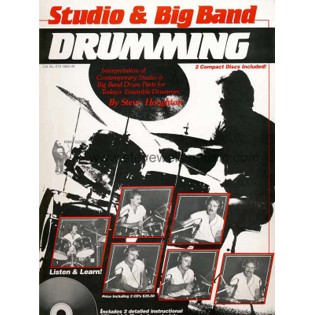
Studio & Big Band Drumming by Steve Houghton - 1985

This has been the definitive book on the subject for almost as long as I've been playing. Includes an essential, very concise but thorough explanation of terms and notation in professional charts. There are one or two page introductions to swing, rock, "Latin" and country styles. The swing section is good, the single page of Latin grooves is pretty dated; people have gotten much more serious about authenticity with those feels since the mid-80's. Probably most important for drummers are the pages on articulating a horn part, the "eighth note rule", and jazz phrasing. There are also many pages of sample ensemble figures, and authentic playalong charts.

College level. 68 pages, with 2 CDs of recorded figures, ensemble passages, and studio charts.


Stage Band and Drummer's Guide by John Pickering

"A guide to reading and understanding stage band charts." An excellent older book from Mel Bay, though I don't know how easy it will be to find a copy. I got mine used on eBay. Completely focused on chart interpretation, which it covers very thoroughly; aimed at somewhat more inexperienced readers, but explanations are presented with subtlety, and are not dumbed-down. Short on actual drumming vocabulary/technique- for that, get Houghton or Rothman. Includes many pages of sample figures.

High school to college level. 96 pages.


It's Time for the Big Band Drummer by Mel Lewis and Clem DeRosa

A unique book which I assumed was out of print until I found it at Steve Weiss Music- maybe it is out of print, and they've just got old copies on hand. It has just eight pages of Lewis' opinionated guidelines on every aspect of the instrument itself- drums, cymbals, heads, sticks, brushes- and two pages of musically-oriented technique, with the whole remainder of the book dedicated to chart analysis. Using a grand staff with the lead trumpet part on top and the drum chart on the bottom, the authors look at several well-known Thad Jones/Mel Lewis band charts, including Cherry Juice, Thank You, and Central Park North, with notes on interpretation.

College level. 46 pages.


Take a Break by Joel Rothman

More narrowly focused than the other books- and more specific about exactly what you are supposed to play- this thoroughly explores creative ways of setting up kicks. There is characteristically little in the way of written text- Rothman is an author who always seems to respect the role of the teacher, and does not over-explain his materials. And as always, he keeps a practical, playable approach. 66 pages.

High school to college level.


Honorable mention: Get Your Fills Together by Sonny Igoe

Another great out of print book, which I just saw in my friend Steve Pancerev's library. It's a classic I used briefly when I was in high school, and was able to leaf through Steve's copy, but didn't take in enough to say anything intelligent about it. Get a copy if you can find it. 

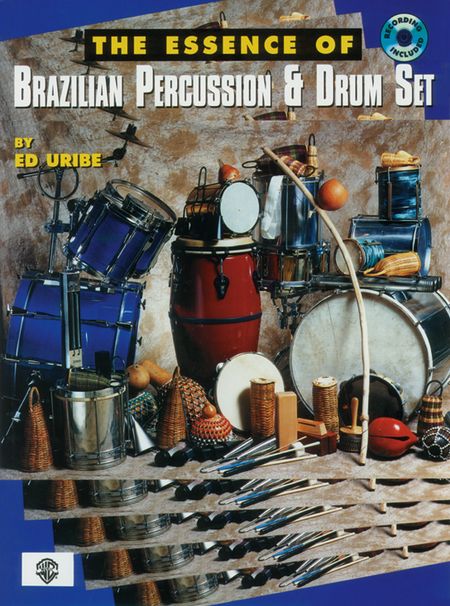
Best books: The Essence of Brazilian Percussion and Drum Set by Ed Uribe

The Essence of Brazilian Percussion and Drum Set is the little sister of Uribe's massive volume on Afro-Cuban percussion. I've been using it almost daily for several months now, and not only is it a model of what a genre book should be, it's quickly turning into one of my favorite drum books, period. It reads and operates- very appealingly- more like a professional manual than a typical drum book (Ralph Humphrey's Even in the Odds would be another one with that feeling about it).

In 144 pages it presents a huge amount of information in very concise, manageable chapters. In addition to practice material, there are sections with historical background of Brazilian music and history, notes on sound of the instruments, explanations of the various song styles, examples of rhythm section parts, and a very useful glossary. Styles covered include bossa nova (in 4, 5, 6, and 7/4), samba (in 2, 3, and 7, plus batucada-style, samba with brushes, samba cruzado) , baiao, samba marcha, partido alto, marcha and frevo, choro/chorinho, afoxe, and catarete. With a number of simple but very robust creative methods presented, it has an extremely open system, and I think no two players approaching it would come out sounding the same.

A large portion of the book is dedicated to introducing each of the common percussion instruments used in samba, which is important even if, like me, you aren't particularly interested in learning to play them all. They are the basis for each of the parts of the drum set grooves, and being familiar with them is one of the keys to playing creatively with any authenticity. That does seem to be Uribe's major point in including them- he does not give a lot of instruction on how to run or play in a bateria.

In some genre books, there is a fairly inescapable feeling that the user is an outsider to the music, and that a high degree of deference is expected. Rather than presenting the music in a folkloric manner, in which the music is more or less fixed, this book has improvisation at the core of its method; the music is presented as very much a living thing, and though not of the culture, the user is treated as a creator and participant.

One of my few reservations about it is that the unique Brazilian swing feel is handled imprecisely, with only general instructions that are maybe a bit misleading (or which at least require a demonstration)- the essence of Uribe's explanation is to slur the "a 1 e" of the repinicado rhythm, and "pull back a little on the time". As you can see from my posts on the subject, my philosophy is that, like with swing in jazz, it should be reduced to something quantifiable and reasonably close- from there it's a short leap for the player to get to an authentic feel through listening and playing. It's one of the most difficult subjects related to this music, so it's an easy shortcoming to forgive, but it would've been nice to see the usage and relationships between even 16ths, triplets, and "tripteenths"- all of which occur in Brazilian music- explored and explained more deeply.

But this is a great book- a true player's book. Highly recommended.

Best books: Studio Funk Drumming by Roy Burns and Joey Farris

Lately I've become very anti-hip and anti-novelty with my practice materials, and the 40-page Studio Funk Drumming by Burns and Farris has that in spades. Written in 1981, and revised in 1994, this book focuses on functional grooves in the style of the 70's and 80's, before the ghost note explosion that followed the massive sampling/rip-off of Clyde Stubblefield, and before David Garibaldi's busier style became dominant (particularly among students and hobbyists). Think instead Jim Keltner or Rick Marotta. Jeff Porcaro. Doing last weekend's Roberto Silva transcription also reminded me of this book.

The first twelve pages of "commercial funk" exercises are dedicated to a system of backbeat grooves, laying common hi-hat variations (with optional openings) over 36 different bass drum parts, with nothing but 2 and 4 on the snare drum. Mastering this section up to a professional standard, in the range of tempos given, is a nice achievable goal, and will certainly give you a lot of space to think about one of the two or three most important things about your playing: the quality of your backbeats. Once learned, I've found it useful for preparing to record, or for fixing tempos that aren't quite comfortable for me. I play the entire thing without stopping, at the tempo in question, four measures of each groove. Things begin to sit nicely after doing that once or twice.

There are good short sections of shuffle and "studio triplet" feels, which don't cover a massive number of grooves, but do give a good foundation for those styles.

There are several pages that are basically obsolete, which I do not use; like the two pages of "funk sambas". The two pages of "fusion funk" introduce but do not develop a variety of more classically "fusiony" ideas, and can be safely ignored. The New Orleans and Reggae sections are usable, with caution- you want to supplement them with a lot of listening. Which is actually true of any book.

The sub-title "a professional workbook" is apt. This book keeps you very focused on time feels you want to have mastered to a very high level of proficiency, and which you can and will actually use in the field. As a funk drummer, your art is in how well you do these sorts of foundational grooves.

Best Books: Basic Drumming by Joel Rothman

In case you haven't figured it out already, I'm a big fan of Joel Rothman's books. His many, many books- I think he has written about a hundred of varying lengths since the early 60's. Basic Drumming is probably the most widely-owned, and contains more than a little of just about everything, without being in any way dumbed-down. A drummer who mastered everything in this book, with an equal amount of performance experience, would be cooking indeed. So the word "basic" is a little misleading.

Rothman has a unique logic to his presentation, which he follows selectively, with a bias in favor of practicality. Often he will use a common performance pattern as a starting place, and then compose a number of variations based on it, which gives the student a starting place, then a number of musical directions to go from it.


Compare that to many books in the wake of Stone's Stick Control, which follow a strictly mathematical logic through every possible combination, without regard for musicality, burying the user in redundancy. Worse are the books that seem to catalog licks, with little on how to get from one to another (cough *Advanced Funk Studies*).

There is very little that is difficult for it's own sake- virtually all of the materials are oriented towards a practical application, developing ideas to the point of covering 98% of what will ever be needed in a performance situation, or for developing general facility. You could say that the book aims to make you expert rather than virtuoso. The only exception to this I can see are several pages of hihat coordination exercises, which go well beyond what most players ever develop.

The book takes the modern-circa-the-70's approach to rudiments; paradiddles, rolls, drags and flams are covered pretty thoroughly, while the more traditional "rudimenty" rudiments (if that isn't totally nonsensical) flamacues, ratamacues, are dealt with only on the two "40 International Rudiments" pages.

Applying the materials in this book mindlessly, without any musical sense, could possibly come off as a little square- it will not aid in hiding non-creativity by spoon-feeding a lot of bleeding-edge-of-hip stuff. A phrase I use a lot, from the Tao Te Ching via the Church of the SubGenius, "stop sucking on the finger and go where it points", definitely applies here. It's an excellent starting point, but the artistry has to come from the musician.

Contains, among other things:
- Very robust 50-page rhythm reading section.
- 15-page roll section. Terminology is interesting- he calls a 6-stroke roll a 5-stroke roll starting on 'e', and a 7-stroke roll a dotted-8th note roll.
- Several pages of stickings over an even rhythm, similar to the beginning of Stick Control. Mostly they are longer than in SC, and follow different logic; there are several pages of two-measure exercises that are through-composed (the longer exercises in SC just repeat the pattern leading with the opposite hand). They are also applied to a triplet rhythm, and there are several pages focusing on strengthening the left hand.
- Several pages of accent studies. The triplet accent pages are especially valuable.
- Flams are dealt with on two pretty decent pages.
- Robust sections on developing drags, short rolls as singles, four stroke ruffs, "open" three stroke ruffs.
- Pages developing doubles, triples, paradiddles.
- Several stand alone pages of variations on different basic groove styles- 16ths in the bass drum, sextuplets with the snare and bass drum, 6/8 feels, 6/8 with 16th notes, shuffles, 16th note rock ballad, alternating 16ths on the hihat, and on and on. I love these pages- they are concise, masterable(?), and 100% immediately applicable to real life playing.
- Marching cadences in 2/4 and 6/8. I can't say I find these very necessary, but younger students will enjoy them.
- Several big band style drum charts.
- Fifteen pages of "dance" band beats, which will get you through most Elks' Lodge, musical theater, dance band gigs and Bar Mitzvahs.

UPDATE: Mr. Rothman informs me "the newest edition of the book, which will be out shortly, contains an extra 8 pages on linear drumming, which I haven't covered in any other book".


Purchase Basic Drumming by Joel Rothman.

Best books: Rudimental Patterns by Joe Cusatis

Rudimental Patterns
Full Drum Set Studies for the Modern Drummer
by Joe Cusatis

This book represents pretty much everything I've always felt is wrong with the traditional approach to learning the drums, and I LIKE IT. For the better part of my study I've always looked for ways to multiply my practice efforts: if I worked on something, I wanted it to work on several levels at once- reading, hand technique, four-way coordination, orchestration on the fly, musical interpretation- as many things as I could fit in, I would. Things like pure, mindless calistenics, and pre-packaged licks (especially out of that traditional Krupa-like bag) were verboten. If it could not be learned through a quasi-musical application, it was not worth learning.

What I'm finding in working through this book (and a few others like it) is that not only do calisthenics actually work, they may be necessary. At the very least they're better for isolating a move and learning it completely and quickly, something more difficult (or easy to gloss over) when you're dealing with several issues at once. What I've found in my own playing is that there is a little bit of an Darwinian process at work, with some moves getting unconsciously weeded out of my playing through never having been learned thoroughly. Now, nobody cares if your left is a little slow making it to your floor tom, but I feel I have a little more freedom for not having to explicitly tell my hands to make certain things.


Many of the licks in the book are very cliche, and will be instantly recognizable if you're at all familiar with the more "drummery" drummers coming out of rock in the 60's- your Ian Paices and Ron Bushys- and your more bush-league Krupa clones. But I've found I actually prefer doing my calisthenics in the context of cliches rather than in the nearly content-free, purely logical/mechanical mode of some newer books (Rod Morgenstein's Drum Set Warm-Ups comes to mind)- I'm learning the moves and learning history at the same time. So far it has not caused me to start regurgitating jive licks verbatim.

I'm not wild about the archaic notation system, which uses a kind of exploded staff-for-dummies, which may have been easier for barely-literate drummers of the past to puzzle through, but is difficult for others to read quickly. It's a minor thing.

 So, another cherished ideal bites the dust. This book is recommended for anyone studying the drums- artist types like me will appreciate it filling in some technical gaps, and novices will appreciate someone giving them something to play.

Get Rudimental Patterns from Steve Weiss Music.

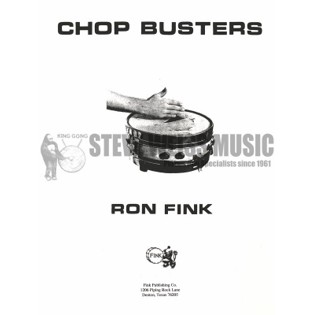
Best books - Chop Busters by Ron Fink

OK, the title is a little goofy- a lot goofy- but this is an excellent, fun book of snare drum exercises written by North Texas State University instructor Ron Fink to "uncover weakness in basic technique" and to "develop a) coordination of finger, wrist and forearm motions, b) sticking accuracy, c) speed, d) dynamics, and e) rhythmic recognition." They're organized by meter (2/4, 6/8, 3/4, 4/4, 2/2, and 12/8) and target tempo, and do not follow the usual mathematically logical sequence, running each idea well into the ground before proceeding to the next one. Exercises are not strictly rudiment based- they primarily deal with singles, doubles, accents, paradiddle variations, rolls, four stroke ruffs, and dynamics. Notably there are very few flam exercises.

There are a number of things I really like about this book. Any single page covers a number of issues, making it good for warming up, or for just giving yourself a break from some of the more mind-numbing technique books (cough *STICK CONTROL*). While challenging, you never get a sense that you are being asked to do something pointlessly difficult- the goal always seems to be to develop practical facility. There is a clear musical intelligence at work in writing and selecting exercises. It has something like the feel of a professional manual, focusing on vocabulary that will be useful in the field, rather than technique in the abstract.

And the price- it's 48 pages long and costs $4.50. A great value. Very fun and very nice to have around.

Get Chop Busters from Steve Weiss Music.