Showing posts with label drums. Show all posts

More with rock beats using Syncopation

Going a little further with my earlier piece on making rock beats using— say it with me— Ted Reed's Syncopation. In doing this, there will be many duplicate beats, but that's not important— our purpose is not to create new beats, it's to apply a thought process: taking a melody line, converting it to a drum beat, and then doing basic modifications to it. It's the beginning of playing with creative control over what you are doing, rather than just playing familiar beats. It's all simple enough that most people will internalize the concepts quickly, and begin applying them purely instinctively.


Be sure to review the previous thing first, and be able to play it with Reed Lesson 4 (pp. 10-11 in the old edition), #1-15, straight through without stopping. The current exercise involves shaping your phrases by doing things with beat one of the second and fourth measures— omitting the bass drum, moving it to one side or the other, or bridging beat one by playing on both sides of it.

Get the pdf

Survival chops: right hand lead

This is the second in an extremely short series covering the bare essentials of what you need for “drumistic” fill, variation, and solo material across a variety of styles— you can read the intro to the previous entry to get a sense of what I'm about here. Usually you arrive at these patterns via a Reed interpretation, but for my purposes here I wanted to present them in their complete state:


Play these with your right hand on the toms, snare, and/or cymbal with the bass drum in unison. Run them in a moderate-to-fast 4 (two or three notes per foot tap, that is), and in a moderate 2 (four or six notes per foot tap). Try to get off of the page as quickly as possible— there are actually only a few basic moves for each rhythm, and you should be able to improvise with these “by feel” pretty quickly.

Get the pdf

Alan Dawson's “Ruff Bossa”

We're laying it on pretty thick with the Reed interpretations right now, but I just went over this with a student, so I need to put up one more. It's a swing interpretation with partially filled-in triplets, using the 8th note rest and syncopation sections of Reed (pp. 29-44 in the old edition). Alan Dawson called this the “Ruff Bossa” interpretation for reasons I can't fathom— there are no ruffs involved, and I can't discern the Bossa Nova connection.

So here's how to interpret each written beat of the exercises, based on how the notes sound; after p. 32  you'll be dealing with rhythms that are equivalent to the ones below, but are written differently.

Play written 8th notes as alternating swing 8ths:


Play written quarter notes (or the equivalent) as an 8th note triplet with a RLL sticking, accenting the right hand:


Play notes sounding on an & only as a triplet with a RRL sticking, accenting left:


On beats where there's no note sounding— like if there's a rest, or the end of a tied/dotted note, or some combination thereof— use whichever triplet sticking you like, but don't accent.

Examples after the break:


Rudimental Reed: ruffs

Today's Rudimental Reed entry is pretty straightforward— just make a ruff out of any note that doesn't have an (untied) 8th note before it.  That's an awkward way of phrasing it, but I think you'll find it's very intuitive once you play the examples. The rudiments covered, or generated, include ruffs, single drags, and double drags, similar to a lot of the things in the Wilcoxon etude Roughing the Single Drag, from Modern Rudimental Swing Solos— I would recommed playing through that as a companion piece to this item.

As always, we'll first see how it applies to the first line of Exercise 1, p. 37 in Syncopation:


I've given both alternating and natural stickings— play it both ways, leading with either hand. I haven't included the multiple-bounce strokes in the stickings, but they happen with the opposite hand. Swing the 8th notes.

Here's a denser example, which is the first line of Exercise 2:


If you have questions about how to play a ruff, there's a pretty good video after the break:


Houghton's triplets

From Steve Houghton's book Studio and Big Band Drumming, here's an alternate sticking method for making triplets out of Syncopation. For most people the most familiar method is to play the melody notes— the written rhythm in Reed— with the right hand, and fill out the triplets with the left. I'll modify that to avoid playing more than two hits in a row with the left, using (as few as possible) alternating strokes. Houghton also puts all of the accents on the right hand, but takes the opposite approach with the inside notes: he plays as many alternating notes as possible, and as few doubles.

Examples after the break:


Here are a couple of examples, from the first long exercise in Reed, on page 37 in the old edition. The first line as written:


Played:


Another line from that page:


Played:


These fairly dense examples don't end up being all that different from the way they would be played using my method; they become much more alternating stroke-dominated when interpreting melodies that have more long notes and rests.

How to get real cymbals when you're poor


The sort of thing you're looking for.
This is really a good time to buy used cymbals-- thanks to the wonderful recession, and the proliferation of extremely high-end cymbals, prices for used merely-pro-quality cymbals are as low as they've ever been. Which is why it kills me to see young drummers spending hundreds of dollars on new student-line junk, which will sound like crap for the few years they will own them before finally sending them to the landfill. For about the same money they could have top of the line cymbals that will last a lifetime while sounding great and retain their value-- most of it, anyway.


So buy used. Really used.
The best bargains are moderately old, very grungy pro cymbals-- dirty, dull-looking bronze, painted-on logos only a memory-- if they ever had them to begin with. You're a musician and you play the things for the sound anyway, right? Then get over this consumeristic, virginity-fetishizing thing of needing to unbox perfectly pristine new cymbals-- that only leads to buying crappy-but-shiny student cymbals when you're poor, and spending way too much money on everything even if you're not.


About those student/economy/budget/semi-pro cymbals
OK, those aren't actually cymbals. You might be able to use them as placeholders for cymbals until you can afford real ones, but consider their value to be basically zero-- the money you spend on them basically goes away forever. I think it's a big mistake to buy them new; buying them used you can and should drive and extremely hard bargain-- I would never pay more than about $50 for a used semi-pro ride cymbal, for example. And do your homework so you know the difference between the almost-usable semi-pro cymbals and the true yellow-tinted sheet metal dreck.


Buy online.
Generally, buying a cymbal without playing it first is an anathema to serious drummers, which tends to drive down used prices online. We're going to take advantage of that.

Much more-- this post is really way too long-- after the break:

We're also going to take advantage of the fact that you (or the person you're shopping for) may be a little inexperienced, and won't be real picky about your cymbals yet. But if you don't like what you get, you can always sell them locally for what you paid for them, maybe a little more. My own experience with shopping this way has been that I've never gotten a true dog of a cymbal-- most of them would work perfectly well for most drummers. Maybe some of the last half-dozen+ purchases I've made may actually have not been things I would've bought if I had played them first, but they have worked out very well for me in my actual playing. I've also passed along a lot of the things I've bought online that just didn't work for me.


Learn how to work the eBay.
Most importantly, get acquainted with the "completed listings" search (do an advanced search, checking the appropriate box); this will show you how much things are actually selling for currently, as opposed to the asking, buy-it-now prices, which can be all over the map, and auction-in-progress prices, which can be absurdly low until the last moments of the auction. Note that some sellers refuse bids from people with no buying history, so if you're just getting started with eBay, you should buy a number of smaller items, so sellers can see that you are going to actually pay for that $100+ item, and in a timely manner.


Be familiar with the cymbal brands, lines and models.
Right now the cheapest pro-quality cymbals appear to be 70's and 80's A. Zildjians and 80's Sabian AAs. I've also been surprised to see a few very good deals on 70's Paiste 2002s. It's worth following some of Paiste's discontinued pro lines from the 80's and 90's as well-- the Sound Formula, 2000, 3000, and Dimensions series especially. Paiste's old semi-pro 505 line is also quite good, and can be found very cheaply.

You want to know the rough weight class behind the obscure, impressionistic labels companies slap on cymbals ("Stage", "Power", "Rock", "Bright", etc, etc). Getting a great deal only to have the cymbal arrive and turn out to be totally the wrong thing for what you wanted to use it for is the opposite of a bargain; that is, a costly problem. Even if it's no big deal to re-sell the thing, it's still a hassle and a time-waster, and you're paying a little tax on the transaction to those twin vampire squid eBay and PayPal.


Knowing a little bit about gram weights is also helpful; it has become the primary way for cymbal purchasers to know exactly what they're getting at least in terms of weight, since normal categories ("medium", "thin", etc) are tend to vary wildly. Here is a chart I pilfered from the Vintage Drum Forum, who in turn pilfered it from the Cymbalholics forum:

Weight Range Table for 22 Inch cymbals:
extra light ------- 1900-2100g
light ------------- 2100-2300g
medium light ---- 2300-2500g
medium --------- 2500-2800g
medium heavy -- 2800-3100g
heavy ----------- 3100-3500g
very heavy ------ 3500 and up

Weight Range Table for 20 Inch cymbals:
extra light ------- 1570-1735g
light ------------- 1735-1900g
medium light ---- 1900-2066g
medium --------- 2066-2314g
medium heavy -- 2314-2561g
heavy ----------- 2561-2892g
very heavy ------ 2892 and up

Weight Range Table for 18 Inch cymbals:
extra light ------- 1272-1405g
light ------------- 1405-1539g
medium light ---- 1539-1673g
medium --------- 1673-1874g
medium heavy -- 1874-2075g
heavy ----------- 2075-2342g
very heavy ------ 2342 and up 

And I just want to say, even if you're a rock player, go to a local store and play a few "heavy", "rock" or "power" labeled cymbals-- and anything heavier than a medium-thin crash-- before you start ordering them blind online. I'm just saying.


The classic all-purpose set-up
You can never go too far wrong with medium hihats and rides, and thin crashes, so if all else fails and you don't know what to get, get these:

A. Zildjian or Sabian AA:
20" medium ride
16, 17, or 18" thin or medium-thin crash
13 or 14" New Beat (Zildjian) or medium/regular (Sabian) hihats

Usually the Paiste equivalent of any of these cymbals will be labeled simply "crash" or "ride" or "hihats."


Get lucky and hold out for the right price. 
Improve your chances of getting lucky by following a lot of auctions. I would consider the magic hold-out number to be around $100 (maybe $115 with shipping) for any cymbal larger than 18", or for hihats. Maybe $60-80 for a 16" crash. That's very inexpensive, and you may have some difficulty closing an auction that cheaply, so you need to watch a lot of auctions for sometimes a period of weeks. Stick to your bottom line; there will be many more cymbals coming down the pike soon enough. As you look at price, don't forget to factor in the cost of shipping.


Learn how to work the Craigslist. 
This will be your means for reselling any cymbals that don't work for you. It's free, and people aren't relying solely on a nice-looking ad to decide on a purchases-- they can actually come over and play the cymbal. Since you held out for a great deal on eBay, you will have a lot of flexibility to give them a great deal and move them along quickly-- you may even be able to turn a small profit, but don't count on it. Just clean the cymbal up a little bit, take a decent picture. It's not a bad place to shop, either-- you can sometimes find bargains equivalent to what you can get on eBay, with the bonus of being able to play the cymbal before buying.


A final word about damaged cymbals.
If you want really low prices, you can consider cymbals with very minor damage or wear to the metal-- significant keyholing, slight edge funkiness (like a very shallow bend, or significant scuffs, "flea bites" or whatever), or slight cracks (meaning < 1/2"). These will lower the price of the cymbal without necessarily harming its playability; I've seen cracked cymbals played  for years or decades without the condition or sound deteriorating further. But I don't necessarily consider these to be a true bargain; you're actually paying the real value of a damaged cymbal, and hoping to get lucky that the thing still sounds OK. Cracks are generally considered to be fatal sooner or later; not so much with the other damage I mentioned. 



Double time feel / half time feel

Hm, maybe being extraordinarily busy will force me to finally do some things that are actually accessible to people. Here's another easy thing, illustrating half time feel and double time feel using basic rock beats. Playing a double time or half time feel in this case means halving or doubling the feel rhythmically within the original tempo-- instead of playing the snare drum backbeats on beats 2 and 4, you play them on beat 3, or on the &s of every beat. A true double time or half time involves an actual change in tempo, and would be written the same as the original beat-- the first two measures of each line-- with a written notation telling you to play half (or twice) as fast.


Play each section with repeats and without, then play the entire page without stopping.

Get the pdf

Expanding on The Kenny Note

What we have here are some very basic comping ideas based on the so-called (by me only, I'm sure) "Kenny" note-- a snare drum punctuation on the & of 1 or the & of 3. A student is having some difficulties bringing his comping practice into his actual playing, and we had some success starting with this approach of starting with one note, and adding things to it:


You could also call this "jazz comping survival chops"; a bare minimum of stuff that will sound like a lot more than the sum of its parts, if applied musically. Memorize the patterns as you practice them, then throw the page away and improvise with them while playing along with a recording or singing a tune. In general you don't want to play them repetitively in actual music; mix them up, and put in more space (where you just play time) between ideas. Listen to recordings of Kenny Clarke or Connie Kay to get an idea of the level of density to shoot for at first.

Get the pdf

Hemiola applications: funk

Here are some very straightforward funk applications derived from the 3:2 polyrhythm in 4/4 in the hemiola basics post. By isolating each measure, revoicing the parts slightly, and adding obvious things like a downbeat on the bass drum or backbeats on the snare, you can make some familiar-sounding funk grooves. I've broken it down into steps for my students:

I've given a couple of optional embellishments-- on part one the bass drum on the 'e' of 4 causes the polyrhythm to bridge the barline, running from the 'e' of 4 to the 'e' of 3; on part two the open hihat on the & of 1 emphasizes that note as the beginning of the polyrhythm.

Get the pdf

Lessons are a whole different thing

Metaphor for complexity.
It's easy to wonder if drummers online are giving away the away the entire store with all of the free video lessons, blog posts and whatnot. With such a massive volume of free information available, what do students need teachers for?

Plenty, actually. Ignoring the fact that most free video "lessons" frankly suck (and that most blog posts are golden), learning even a straightforward written exercise is a complex process of coordination, technique, reading, comprehension of rhythm, touch, general physical posture, dynamics, and tone production, for starters. Most students are aware that those are words, but do not know how to implement them and balance them with each other in practice. In helping a student find an entry into some materials, there is a lot of:

"Do this-- no, not that, this-- no, this-- not quite, fix this one thing... good, almost... take a second and work that out, but pay attention to this, not this... wait, there's something you're doing that's very subtly wrong, let's fix that-- good, now you understand it well enough to practice it on your own." 

That's when things are going well; often you can throw into the mix some:

"OK, this isn't working, let's take it slower--- no, slower--- no, slower. Right, you need to take this slower. Good, it's still not happening. Let's break this town a little bit-- that's not working-- try it this way instead... still no good-- try just this piece of it. Great, add one more note..."

Beyond that, there is the matter of placing the practice item in context: How and how much does should he practice it? What more can he do with it? How does it connect to other things? How does he integrate it into his playing? How is it going to turn up in real-world drumming?

It can take considerable knowledge and ingenuity, instantly accessible. Most self-teachers can't cope with the multiple levels of real-world uncertainty in the process. And no written item or video, no matter how detailed, can address all of things that come up. Even if it could, the student would have to be able to digest it, and accurately self-monitor all of this stuff. Both of which are highly dubious prospects.

Stick Control in triplets

Here's a good library companion to my Stick Control implied rhythms piece. This was suggested to me by my friend Steve Pancerev-- I'm not sure if it's something he thought up, or if it was suggested by his old teacher, Ian Froman. The concept is simple enough-- just apply the stickings from the first section of Stick Control to a triplet rhythm-- figuring out on the fly how that lays is more challenging, though, so I've written it out. You might pencil in phrase marks to outline the four note groupings where they're not so easy to make out.


Usually you just run exercises 1-13, but what the heck, I went ahead and wrote up the whole page. The big challenge here is to play the RH part on the snare drum and the LH part on the bass drum along with jazz time on the cymbal and hihat. You could also play the RH part on the cymbal, doubled with the bass drum, and the left hand on the snare drum.

Get the pdf

Hemiola basics

The hemiola-- also called the 3:2 polyrhythm-- is a basic polyrhythm using layered even two and three note rhythms. What I've done here is outline some ways of building it, and begin relating it to some of its common forms in a variety of time signatures. There's a lot of meter-shifting trickery going around these days, often as a somewhat crass effect, but that's not what this is. It is actually a DNA instruction, a foundational part of all drumming with African origins, including all music using the drum set. Without it, American drumming would just be marches, two-beats, and ye olde four on the floor. In fact, when you hear a drummer sounding a little too squared-off in his approach, I believe it usually comes from lack of understanding of this concept.


I suggest repeating each measure of line 2 by itself as well- that didn't make it into the final pdf for lack of space.

The idea is not to learn these as a lick, so I've specifically not given any complete drumset parts. Just play (and count) through the examples, using all combinations of limbs, and let it enter your playing "on background." If you want to take them a little further, you could play them along with a simple one- or two-limb ostinato. It might also be worthwhile to experiment with accenting, or moving hands between sounds.

Get the pdf

Metronome perspectives

There's an excellent piece on the Modern Drummer site getting views on metronome use from a number of top drummers and educators. I've excerpted some of the best bits, but go read the whole thing.


David Stanoch:
One tip for making friends with your metronome, which comes directly from a 1984 Modern Drummer interview with [Andy] Newmark, is to imagine the click to be your friend. Andy said he thinks of the late, great studio percussion icon Ralph MacDonald playing a cowbell. By making that his mindset, he could relax and play comfortably with the metronome’s time.


George Marsh:

As a practice tool, I like to use the metronome as a guide to help check rhythmic accuracy. And it can be used in creative ways. Back at a recording session in 1973, I had the pleasure of hearing African master drummer Kwasi Badu play a bell pattern using a metronome to mark the third note of each pulse in 12/8 meter. He heard the metronome as a representation of the beginning of one of the supporting drum parts, which didn’t start on the downbeat. Badu then proceeded to build on the bell pattern with the metronome still playing in its displaced position. The piece was a version of the West African dance Adowa. Kwasi overdubbed all of the parts this way.

From then on, I tried to think of many ways to make use of the metronome more creatively. One way is to set the metronome to any tempo and then play completely freely, with the only rule being that I keep listening—but not adhering to—the metronome. I just let myself fly around the beat. After doing this for a few minutes, I then land on the beat and play in time.


Jeremy Hummel :
Going around the turns. Most drummers, at some point, struggle with speeding up when playing fills, especially in transitional moments (verse to chorus, chorus to bridge, etc). Fills should be played in time, with taste and musicality. I find the best fills to be an extension of the groove, rather than a disruption. Practicing beats and fills with a metronome will help to keep the heads bopping—and not stopping.

More after the break:

Marc Dicciani:
I believe one of the best ways to develop good time is to internalize the tempo first. If you’re going to practice a lot with a metronome, make sure that you’re trying to feel and move to the pulse. Keeping your limbs relaxed and moving fluidly in time with the pulse or music will help develop your feel and groove, which will also improve your time. I also recommend setting the metronome to quarter notes or half notes (depending on the tempo and time signature), so the notes between them (8ths, triplets, 16ths, etc.) can breathe a little. In jazz, rock, folk, second-line, Cuban and Brazilian styles, and even symphonic music where there’s no drummer, the time breathes and the music feels great.

If you practice correctly, your time will naturally improve the longer you play. I’ve heard drummers who can play rudiments and rhythms perfectly matching 16th notes with a metronome but who have trouble playing with a good feel when they sit at a drumset. That’s why I strongly encourage my students to practice to music, recordings, and loops; play in a band; and listen to and analyze a lot of music in order to develop a good sense of time and musicality. Many of our musical and drumming heroes never even owned a metronome; they developed good time by practicing, playing, and listening.


Jim Riley:
I’ve heard session drummers talk about playing behind the click or playing on top of it. This never made a whole lot of sense to me. I mean, if you play the whole song behind the click, you’re still playing with the click—you’re just landing a few milliseconds later. I would hear other players talk about playing around the click, where they’re playing behind it during the verse and ahead of it in the chorus. But in the age of Pro Tools, where rhythm guitars and shaker parts are snapped to the grid most of the time, I don’t have that luxury. Therefore, it’s my job to make the music feel great even when playing in the center of the beat. That means I have to be aware of my tendency to want to rush fills at slow and medium tempos and work on controlling that.


Jason Gianni:
I don’t know if practicing to a metronome can actually make your time worse, but it can certainly affect your feel if you become too dependent on it. In addition, having a click constantly present can perhaps cause stiffness in feel, or if you pay too much attention to sticking with the metronome other areas of your musicianship may be sacrificed.


Claus Hessler:
I think of practicing with a metronome as like playing with an extremely stubborn percussionist.

(h/t to Bill Bachman, who is also featured in the piece)

5s around the drums

I've enjoying practicing my previous around-the-drums things so much, I thought I'd run it through a few iterations- similar to my multi-page paradiddle exercise- and see what we get. Today it's 16th note 5s, using  the easily-flowing RLLRR/LRRLL sticking:


As I've outlined previously, once the single measures are happening, start combining measures- the notes in parentheses are to facilitate that without having to do a crossover. On the second page I've also given some formats for playing these as 8th notes or 16th notes in 5/4 or 5/8.

Get the pdf

Tom moves

This Elvin thing is turning into a real epic- well, a very small epic, maybe, if you think about it- and I still have to complete the transcription. Here are the tom moves I would apply to the left hand part on yesterday's post- you can/should do these with any other left hand coordination materials, too, of course.

Key:
S = snare drum (normally, or as a rim click)
H = high tom
L = low tom

Between two drums: 
S H S H
S L S L
H L H L

Away from/back to one drum:
S H S L
H S H L
L S L H

Up and down the drums: 
S H L
S L H

You can extrapolate your own patterns if you have one of those monster drumsets with three tom toms. I like to do things the easy way, so I do the moves when there's plenty of time- I don't split the doubles between drums. Depending on the number of notes in the rhythmic pattern vs. the particular move above, there will often be a little polyrhythmic counter-melody generated by doing these- it's a good idea to count out loud and keep track of the four measure phrase in that case. When doing this Elvin thing, for example, count 1-2-3, 2-2-3, 3-2-3, 4-2-3.

How much to practice something

1. Get wood chisel.
2. Remove everything that doesn't look like
Billy the Kid deftly gunning down Bat Masterson
before the throng of stunned onlookers, a yapping
yellow hound at his feet.
3. SUCCESS!
One of the big persistent things nagging most drummers is the question of how much to do. When have you practiced something enough to consider it basically learned, so you can move on with confidence? Some teachers and other not-very-helpful individuals will tell you to just do everything, a lot! You have to be good, man! Were you aware that Weckl practiced 12 hours a day for X years? 

That's great, thanks. You make a mental note to dump a drink down his back at some point, and go back to living with the uncertainty. It's a familiar story.

Here, then, are some guidelines; in general, you can begin to feel you've learned a thing when:

It's memorized. At least so you don't have to look at the book while you play it. You don't necessarily need to be able to pull up everything from memory at a later date. And this doesn't apply to reading practice, EG: the long exercises in Syncopation.

You can play it in a practical range of tempos for the associated style. Part of your job is to listen to music so you know what that range is. If you're playing through some, for example, bossa nova related materials, you should feel good with them from about 88-180 bpm, and especially from 120-150.

"...a relaxed groove develops." One of the best suggestions in Even in the Odds. Try to achieve that at least at one tempo in a single practice session.

You have control over your dynamics. You can play it louder and especially much softer than your "generic" practice volume.

You can play it from a stop. The complete thing; no starting with one or more limbs and adding the hard part last. This is very challenging for a lot of students; often you can do it by just isolating the first few notes of the pattern.

More after the break:


You can get into it from something else without stopping. At least from the previous exercise, but maybe also from a generic time feel in the style. If you're working on an elaborate funk beat, be able to get into it from a more basic funk beat.

You can recover from mistakes. Without losing track of where you are in the measure- you should at least know where the next down beat falls. An intermediate step towards this is to at least not lose the tempo you were playing (assuming you weren't using a click) and jump back on it.

Your mistakes stop sounding like mistakes, and more like variations. They are accurate and in time, and played with a good sound- you played a good note in the "wrong" place according to the stupid book. I don't call those mistakes, actually, I call them "music trying to happen." You should try to harness those accidents a little bit- try to repeat them when they happen, or at least understand what you did.

You can make variations on the fly, or fills, and get back to the original thing. Formats for practicing this could be:

||: 1x as written | 1x variation :||
or 
||: 3x as written | 1x variation :||
or 
||: 2x as written | 1x variation | 1x as written :||     


At that point, you can consider yourself basically competent with a piece of practice material, and can safely move on to the next thing. Some things you'll want to work on much more, either because they're so fundamental to drumming you have to work on them forever, or you need to have them highly developed for the kind of drummer you want to be, or because want to make them a special part of your personal thing.

In general, you don't need to trouble yourself with:


Learning everything at extremely slow or extremely fast tempos. These are a real productivity-killer. In actual playing, each of those situations are somewhat special circumstances that call for dedicated practice time apart from your regular routine. Keep in mind that you do need play new things slow enough that you can do them perfectly- sometimes that will put them at what feels to you like an extremely slow tempo.

The millions of variations/modifications you can do on any written thing. I can pile on so many things to do with a basic rock beat that you would never get past the first thing in the book if you tried to do them all at once. Don't practice that way. Get the one thing at hand, and move on.


All of the above don't necessarily apply exactly equally to every single thing you do. You (and your teacher) have to be able to judge the difference between core things on which your entire drumming career depends (which you need to practice a lot), and things that are more background facility-developers (which can grind you to a standstill if you try to do too much with them). For jazz drummers, most of the things done with Syncopation would fall into the first category; Dahlgren & Fine would fall into the second.

Typos in Funky Primer

Time to get out your white-out again. This is something that had been bugging me for many years of working with A Funky Primer, by my old professor, Charles Dowd. Most of the book consists of bass drum and snare drum combinations along with 8th notes on the hihat. A few places, though, there are these oddball patterns where the hihat falls on the e's and a's:


There's nothing wrong with the pattern, I guess, except that it makes no sense in context- there's nothing else like it anywhere in the book, except these few random measures. After a couple decades of just ignoring those patterns, it dawned on me that when you beam the notes this way:


The result is exactly what you would expect for that page of the book. I imagine the copyist was getting in a groove with his work, and got a little cocky about knowing where the beams were supposed to go without double-checking his master copy, and screwed it up.

A couple more of these after the break:

These two are from the "hands only" part of the book:


Properly beamed this becomes:

And this pattern:


Becomes:

Several big band drumming books

A couple of new/old big band drumming books dropped into my lap recently, so what the heck, I thought I'd round them up for you:

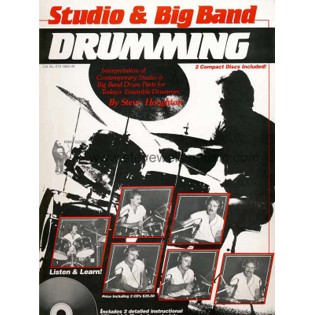
Studio & Big Band Drumming by Steve Houghton - 1985

This has been the definitive book on the subject for almost as long as I've been playing. Includes an essential, very concise but thorough explanation of terms and notation in professional charts. There are one or two page introductions to swing, rock, "Latin" and country styles. The swing section is good, the single page of Latin grooves is pretty dated; people have gotten much more serious about authenticity with those feels since the mid-80's. Probably most important for drummers are the pages on articulating a horn part, the "eighth note rule", and jazz phrasing. There are also many pages of sample ensemble figures, and authentic playalong charts.

College level. 68 pages, with 2 CDs of recorded figures, ensemble passages, and studio charts.


Stage Band and Drummer's Guide by John Pickering

"A guide to reading and understanding stage band charts." An excellent older book from Mel Bay, though I don't know how easy it will be to find a copy. I got mine used on eBay. Completely focused on chart interpretation, which it covers very thoroughly; aimed at somewhat more inexperienced readers, but explanations are presented with subtlety, and are not dumbed-down. Short on actual drumming vocabulary/technique- for that, get Houghton or Rothman. Includes many pages of sample figures.

High school to college level. 96 pages.


It's Time for the Big Band Drummer by Mel Lewis and Clem DeRosa

A unique book which I assumed was out of print until I found it at Steve Weiss Music- maybe it is out of print, and they've just got old copies on hand. It has just eight pages of Lewis' opinionated guidelines on every aspect of the instrument itself- drums, cymbals, heads, sticks, brushes- and two pages of musically-oriented technique, with the whole remainder of the book dedicated to chart analysis. Using a grand staff with the lead trumpet part on top and the drum chart on the bottom, the authors look at several well-known Thad Jones/Mel Lewis band charts, including Cherry Juice, Thank You, and Central Park North, with notes on interpretation.

College level. 46 pages.


Take a Break by Joel Rothman

More narrowly focused than the other books- and more specific about exactly what you are supposed to play- this thoroughly explores creative ways of setting up kicks. There is characteristically little in the way of written text- Rothman is an author who always seems to respect the role of the teacher, and does not over-explain his materials. And as always, he keeps a practical, playable approach. 66 pages.

High school to college level.


Honorable mention: Get Your Fills Together by Sonny Igoe

Another great out of print book, which I just saw in my friend Steve Pancerev's library. It's a classic I used briefly when I was in high school, and was able to leaf through Steve's copy, but didn't take in enough to say anything intelligent about it. Get a copy if you can find it. 

Six stroke rolls around the drums

I'm just cranking them out today. I've been using the last paradiddles around the drums thing so much I decided to write up something similar using another familiar solo pattern, the six stroke roll (as it's often called) in a sixtuplet rhythm: RLLRRL. What they really are is a paradiddle-diddle inversion. I've written them in 6/8, but you can play them in 2/4 as sixtuplets, or as 16ths in 3/4, giving a 6/8 feel, or as 16ths in 4/4, for a meter-within-meter thing. Or as triplets within a fast 4/4. I'll write up an outline of the possibilities when I have the time. This rudiment is usually played with accents on the singles- I suggest playing these with and without them.

Refer to the paradiddles post for more ways of practicing these.

Oh, and go see Andrew @ the Melodic Drummer- he's put up some around-the-drums conditioners of his own.

Get the pdf

Kernels of Cascara

My students have been doing so well with my "kernels" concept that I've decided to write up a real challenge for them: cascara with the clave in the left foot. It was the hip thing du jour two years ago, and it will still blow away the other kids around the band room. The kernel of the kernel concept is to find the natural clumps of notes within a pattern, and practice them in isolation at the final performance tempo, or close to it, and then stringing them together.


As I've said before, the cool thing about this approach is that it helps fairly inexperienced drummers to get difficult things up to speed in fairly short order. It also insures that the internals of the pattern are solid. I've found it to be a nice addition to the usual slow-to-fast  way of overcoming coordination challenges, and much more effective than the equally common (in the practice room, anyway) brute force approach, in which students inevitably spend a lot of time practicing mistakes.

Instructions are in the pdf; it's a good idea to count each kernel out loud as written as you play them. After mastering the coordination by this method, it's important to bring it back around to perceiving the groove in its usual musical sense, paying special attention to how you are interpreting the palito pattern in the right hand and the clave in the left foot.

Get the pdf